/* Google Analytics */

Saturday, August 24, 2013

Potential payoffs from ubiquitous BIPV

As an MIT alum interested in clean energy, I subscribe to the free semiannual magazine Energy Futures.

The purpose of the magazine is to tout MIT advances in energy technology, but since MIT (with the MIT Energy Initiative) is one of the world's cutting-edge energy research labs, I find that it is often a provocative look into a possible future that may or may not* come to fruition. (*The technology may not work, it may not scale, it may not be cost effective, something better may come out, etc. — such are the risks of technology entrepreneurship).

In the spring issue, one article describes the work of Prof. Vladimir Bulović, recent PhD grad Miles Barr and ex-postdoc Richard Lunt to create transparent solar cells. The cells absorb energy in the UV and near-infrared, but only about 30% of the visible light. This would allow the PV cells to become just another layer on a building’s windows, and could also use the window class to protect the (currently fragile) layers from the elements.

[Spectral response]

Right now, the efficiency is only 2%, but are hoping to get the efficiency up to 10-12%.

As with any BIPV (Building Integrated Photovoltaic), integrating the PV into windows would eliminate most of the installation cost; it would also mean that the PV is not an obstacle in use of the existing roof, interfere with drainage, need to cope with snow accumulation, etc.

The big win seems to be for large commercial buildings. The article claims that a 5% efficient PV cell could generate 25% of a building’s electricity. Absorbing near IR would reduce cooling in the summer (but increase heating in the window). With such a cost-benefit, the builder of a new commercial building would invest in such efficiencies (even ignoring the LEED bragging rights) while a consumer might worry about increasing the price of a house $20-50k (and would also tend to have more shading problems). If every new skyscraper had such BIPV, it would both generate a lot of energy and also be a big market.

To exploit the opportunity, the three men formed a company called Ubiquitous Energy, where Barr is president and CTO, and the other two are on the scientific advisory board. They have a $1m in seed funding and $375k in SBIR funding so far.

Like any tech startup, it’s a gamble — but this seems one with a big payout if they can solve all the challenges.

Sunday, June 30, 2013

Where will the clean energy come from?

Last week, the president proposed a new push to reduce GHG. It’s not clear how (or if) the Congress will go along, or how much can be legally accomplished without legislative support.

One of the major targets is, as expected, coal generating electricity plants. Obviously the coal miners and the coal-intensive electric companies would try to push back, but again, it’s unknown how successful they will be. It’s also not entirely clear what the point of reducing US coal consumption is, if the entire US consumption is about a billion tons while Chinese demand has risen from 3 to 4 billion tons in only 5 years and India is also increasing coal generation.

That said, if the plan (or some other approach) succeeds in getting rid of US coal plants, where will the replacement electric generating capacity come from?

Hydro is maxed out, and wind and solar can only ramp so quickly. The remaining no-CO2 option is nuclear, but it’s becoming increasingly uneconomic. As the WSJ reported last week:
Nuclear power produces two-thirds of the nation's emission-free electricity, but that industry is in the doldrums now because of slack power prices in deregulated markets and generally low demand for power. The plants also suffer from high fixed costs.

Dominion Resources Inc., D +0.60% a big owner of nuclear plants and utilities, shut down its Kewaunee nuclear plant in Wisconsin last month because it can't operate it profitably in the current energy environment. "Longer term, nuclear has to be a major part of the solution," said Tom Farrell, chief executive of Dominion, which is based in Richmond, Va.
Nuclear is plagued by high capital and other fixed costs, despite low variable costs. With natural gas prices plummeting, it’s hard to see how it will ever be cost-competitive again.

Natural gas generates half the carbon emissions of coal plants, but that’s still more than zero. Fixed costs (and nuclear waste) aside, nuclear would be a better GHG solution but one that seems increasingly out of reach.

Sunday, May 19, 2013

Hopes and dreams for the Department of Energy

The Senate last week unanimously confirmed MIT physicist Ernest Moniz as the new Secretary of Energy. As an MIT alumnus, I’m proud — but as an organizational scholar and (part-time) energy economist, I'm somewhat apprehensive.

A cabinet secretary is not just a domain expert, but a politician and an administrator. Sometimes capable politicians with domain expertise get appointed to the cabinet (John Kerry, Donald Rumsfeld) and other times they are mediocre politicians with little particular expertise (typically at Agriculture, Labor or Transportation).

College professors tend to be long on domain expertise and short on political or administrative abilities. Academic administrative experience tends to be a poor predictor of success in managing a federal bureaucracy. Harold Brown left the presidency of Caltech to become Jimmy Carter’s defense secretary, and probably was more helped by his Johnson-era DoD experience than anything he learned at Caltech.

Moniz is the second academic physicist appointed by the president to a job that once seemed crucial to his intended legacy. The first, Nobelist Steven Chu of UC Berkeley, was appointed at a time of seemingly unlimited resources to spend on research and fledgling cleantech companies.

Secretary Chu was obviously very smart, and his passion was in funding research, which he was able to do. However the climate changed after the Democrats lost the House in 2010, and after the bankruptcy of five DoE-funded startups (A123, Abound Solar, Beacon Power, Ener1 and Solyndra). At that point, any secretary trying to implement the president’s policy goals would be facing strong headwinds.

Even so, I’d be hard pressed to call Chu a success as an administrator and leader. Apparently I was not the only one who was unimpressed. An energy industry publication, Power magazine, was harsh in its assessment:
I believe it is fair to say that Chu was a failure at DOE, but nobody noticed. That’s not necessarily a harsh indictment. There have been, in my estimation, no successes at DOE. And that’s because it is an impossible job, created under circumstances that dooms the incumbent to failure. The Department of Energy is, to be honest, a fraudulent entity. It has almost nothing to do with energy, although Chu and his boss, President Obama, tried to transform it into an institution that somehow has relevance to the way Americans make, use, and pay for energy. Both failed…
As the National Journal reported upon Chu’s resignation, his lack of political skills were a mixed blessing: at first Congress enjoyed dealing with a non-politician, but when the going got tough, Chu was hobbled in his ability to represent (or lead) his agency.

I know little about Moniz other than his online biography. He was the founder of the greatly respected MIT Energy Initiative, which includes both science and also MIT’s decades-long experience with science policy. Before that, he was an undersecretary in Clinton’s DoE. His official home page lists a 2002 article on energy policy from Physics Today. Other than its embrace of “all of the above,” it’s about what you’d expect given his resume.

In the end, however, I think the past decade demonstrates that the emphasis on physics in energy policy is vastly overrated. Anyone with a college degree (except maybe a lawyer) can be taught about the four laws of thermodynamics and how to break down the 100 quads of energy produced and used in the U.S. every year.

However, energy is not a scientific problem, and only somewhat a business and systems problem. Fundamentally, it’s an economic problem: we have many sources of energy and for many uses (e.g. grid-connected electricity) the sources are completely fungible. The challenge facing the DoE and the government is simple: how do we most cost-effectively deliver the energy needed by American society to enable economic growth? Yes, R&D for new technologies will change that picture over time, but even with cool new technologies, the final resolution is an economic — what can we afford — rather than technical one.

Saturday, May 4, 2013

Rise and fall of the world’s biggest solar company

In 2011, Suntech Power Holdings was the world’s biggest solar panel producer, shipping more than 2 gigawatts of panels. As Wayne Ma of the Wall Street Journal reported today:
Suntech is now in Chinese bankruptcy court, and [founder Zhengrong] Shi isn't allowed to leave China without court approval, as is customary with non-Chinese executives involved in bankruptcy proceedings
The article is a must-read for anyone who follows the solar industry.

One reason is the dramatic turnaround of the personal fortunes of Shi, a Chinese-born Australian citizen. With his holdings in Suntech, Shi was on the Forbes list of billionaires (with a net worth of $2+ billion) in 2006 and 2008. The WSJ says his holdings were worth $4 billion in 2007 but “around $31 million” today. The pictures also show a man dramatically aged in the past five years.

The failure of Suntech has been assumed to be due to falling solar prices, but this is a pressure that all Chinese producers are facing. It was highly leverage, borrowing heavily to grow capacity and volume after the financial markets collapsed in 2008.

However, there were also unique problems of self-dealing and fraud. The WSJ focused on the investments of Suntech and Shi in Global Solar Fund, which financed European sales of Suntech panels. The story is complicated, but apparently the GSF manager posted fraudulent security for a €554 million Chinese government loan. When GSF got in trouble, the fraud was discovered, and Suntech (an NYSE-listed firm) was forced to report the GSF liabilities on its books and found itself unable to refinance more than $500 million in corporate bonds.

A second questionable deal was that Shi founded a polysilicon producer, Asia Silicon, and provided the unproven startup with both financing and more than $1 billion in purchase contracts. Suntech's failure to disclose its dealings and Shi’s conflict of interest are the subject of a class action shareholder lawsuit filed in San Francisco last year — a lawsuit that’s curiously been ignored by the US media.

After a 2005 IPO and a peak price of near $90, Suntech shares closed Friday at $.61 after trading under $5 for the past 18 months. For Shi, his dreams of creating an enduring industrial empire have been destroyed, as has his personal fortune.

Monday, February 11, 2013

Magnifying rather than quelling range anxiety

In the ongoing search for electric car nirvana, the Tesla Motor Company has enjoyed an unusually charmed existence. Perhaps it’s the Silicon Valley mystique, perhaps it’s the Midas touch attributed to its co-founder Elon Musk — who became a centimillionaire from selling PayPal to eBay, and then used his funds to start a car company, a rocket company and a solar company.

After discontinuing its $100k niche toy, the Tesla Roadster, the future of the company depends on producing and selling its $60-100k Model S sedan in volume. The latter effort was dealt a major blow Sunday when the NY Times reported the very real problems in an actual test drive:
Stalled Out on Tesla’s Electric Highway By JOHN M. BRODER

Washington — Having established a fast-charging foothold in California for its electric cars, Tesla Motors has brought its formula east, opening two ultrafast charging stations in December that would, in theory, allow a speedy electric-car road trip between here and Boston.

But as I discovered on a recent test drive of the company’s high-performance Model S sedan, theory can be trumped by reality, especially when Northeast temperatures plunge.
The problem was that — after several close calls — the car ran out of power shy of the next charging station, requiring a complex and time-consuming flatbed tow. Perhaps it was the effect of cold upon the battery life, perhaps it was the power consumed by the heater, perhaps it was bugs in the software or hardware.

Still, there’s no reason to think that the problems didn’t actually happen. In response, one would presume that Tesla would both improve its products and add additional charging stations to enable long-distance recharging.

Instead, the notoriously thin-skinned Musk tried to smear the messenger, both on a CNBC interview and on his twitter account:
@elonmusk: NYTimes article about Tesla range in cold is fake. Vehicle logs tell true story that he didn't actually charge to max & took a long detour.
In responses to major media outlets, the NYT stood by its story:
The Times's February 10 article recounting a reporter's test drive in a Tesla Model S was completely factual, describing the trip in detail exactly as it occurred. Any suggestion that the account was "fake" is, of course, flatly untrue.

Our reporter followed the instructions he was given in multiple conversations with Tesla personnel. He described the entire drive in the story; there was no unreported detour. And he was never told to plug the car in overnight in cold weather, despite repeated contact with Tesla.
Apparently the attack was an effort to prop up the stock price, which fell 4% in response to the NYT story. (That’s about $175 million in market cap — more than any of us mere mortals will ever see in a lifetime).

Despite the stress on the company and its stock, this is a textbook example of how not to handle a PR crisis. But it appears that within a NASDAQ-traded public company, no one can tell the emperor of Tesla to put his clothes on, or to listen to professional advice. As The Atlantic summarized its media report: “Elon Musk's Crusade Against The New York Times Isn't Helping Tesla.” The WSJ wonders whether this sort of concerted effort to intimidate reviewers will discourage coverage in the future.

Of course, this happened the same week that Musk — an expert in all things everywhere — was offering advice on Boeing 787 batteries. As Seeking Alpha dryly put it:
Tesla has burned through $1.25B in free cash flows in order to develop the company, and we expect that terrifying test-drives of electric vehicles from Tesla Motors will continue. We find it amusing that Elon Musk is willing to help out Boeing's Dreamliner due to the battery issue. We would like to remind Elon Musk and his team that they need to first fix their problems with their products before trying to be a superhero with the products of other companies.
Cruising range is an inherent limitation of the current generation of electric cars, and thus “range anxiety” will be a major obstacle to adoption. Musk has done himself — and the industry — no favors by helping to call attention to the article, rather than (as his employees apparently were trying to do) work with the reviewer to understand and correct the problems.

Thursday, November 1, 2012

Are biofuels doomed without subsidies?

A molecular biologist (turned biofuels entrepreneur) made a stark prediction Tuesday:
Famed genomics researcher J. Craig Venter, who is working to develop biofuels from photosynthetic algae, acknowledged this week that alternate fuels are “dead” unless the federal government mandates their use with a carbon policy.

Venter’s strongly worded statement came Tuesday night at the annual Stem Cell Meeting on the Mesa, after he was asked when synthetic biology might have a meaningful impact on the country’s energy production.

Without strong government intervention, Venter said, that day will never come. He works on biofuels, human health and other issues at Synthetic Genomics, the La Jolla company he co-founded. It partnered with ExxonMobil in 2009 to develop algae biofuels.

“It doesn’t matter what the scientific breakthroughs are, there’s no way to ever beat oil,” Venter said. “In fact, oil’s not even an issue right now because of all the new natural gas discoveries.

“So there’s no way economically for a new fuel made out of renewables to ever be able to compete with something an oil company can do, without sharp federal regulations and a sharp carbon policy that says, you can’t keep just taking carbon out of the ground, burning it and putting it in the atmosphere. Until we do that, there is no biofuel industry.”
Venter is no stranger to big bets (or government intervention). His Celera Genomics raced the NIH (and its Human Genome Project) to sequence the first human genome, which cost several billion dollars.

Now Venter is hoping for government intervention — implying a carbon tax on natural gas and other fossil fuels — to raise their cost enough to support synthetic biofuels.

However, the story by life sciences reporter Bradley Fikes suggests that the key problem is not subsidies (or taxes on competing technologies) — in part because taxes on oil would reduce demand and thus prices. Fikes quoted Berkeley energy economist Severin Borenstein:
Regulatory mandates to compel adoption of biofuels probably wouldn’t work, Borenstein said.

“It may work for the United States, and even that seems a political stretch, but it doesn’t really matter if it doesn’t work in the developing world,” he said. “The idea that the developing world is going to forgo cheap gasoline to use much more expensive biofuels, I think is fairly implausible for the near term.”

Science may provide answers in the long term, he said.

“I’ve come around to the view that we need to put a lot more into research and development and pursue every possibility, whether it’s biofuels or electric vehicles, in order to find something that could be cost-competitive,” Borenstein said.
The latter point suggests one of the major disconnects in the biofuels world, between the energy industry veterans who work in the market and the university molecular biologists who are used to NIH and NSF funding all their research. Is it time for biofuels to go back to being a series of university science experiments rather than being the basis of publicly-traded high-tech startups?

Monday, October 8, 2012

Candidates duck energy debate

In anticipation of the first presidential debate, I was interviewed by a representative of LA’s second largest newspaper group. Here’s how it appeared in the front page of the Los Angeles Daily News:
From oil refineries in the South Bay to millions of motorists and other consumers, federal energy policy is critical to this region.

If President Obama truly favors a so-called "all-of-the-above energy strategy" that supports a mix of traditional and newer energy sources, some asked why do his policies restrict availability of coal, oil and even natural gas?

"I'm not sure what Obama could tell me to convince me that he sees a future role for fossil fuels," said Joel West, a professor of innovation and entrepreneurship at the Keck Graduate Institute of Applied Life Sciences in Claremont. "I'd more want to put him on record in supporting these things so later on he could be held accountable for that."

By contrast, Romney has emphasized traditional energy sources by calling for more oil drilling and fewer industry regulations in general.

"I'd like Romney to recognize that there are certain cases in which renewable energy can be successful today or can soon be successful with a little bit of government support," West said. "Because otherwise he risks being perceived as another stooge for the oil companies."
Due to a work commitment, I missed the debate but was later able to review the transcript. It appears that my worst fears were realized.

This is what Obama said:
I think it's important for us to develop new sources of energy here in America,

On energy, Governor Romney and I, we both agree that we've got to boost American energy production, and oil and natural gas production are higher than they've been in years. But I also believe that we've got to look at the energy sources of the future, like wind and solar and biofuels, and make those investments.
And here is what Romney said:
Energy is critical, and the president pointed out correctly that production of oil and gas in the U.S. is up. But not due to his policies. In spite of his policies.

Mr. President, all of the increase in natural gas and oil has happened on private land, not on government land. On government land, your administration has cut the number of permits and licenses in half. If I'm president, I'll double them, and also get the -- the oil from offshore and Alaska. And I'll bring that pipeline in from Canada.

And, by the way, I like coal. I'm going to make sure we can continue to burn clean coal. People in the coal industry feel like it's getting crushed by your policies. I want to get America and North America energy independent so we can create those jobs.
And then the candidates had this exchange:
ROMNEY: [T]he Department of Energy has said the tax break for oil companies is $2.8 billion a year. And it's actually an accounting treatment, as you know, that's been in place for a hundred years. Now ...

OBAMA: It's time to end it.

ROMNEY: And in one year, you provided $90 billion in breaks to the green energy world.

Now, I like green energy as well, but that's about 50 years' worth of what oil and gas receives. And you say Exxon and Mobil. Actually, this $2.8 billion goes largely to small companies, to drilling operators and so forth.

But, you know, if we get that tax rate from 35 percent down to 25 percent, why that $2.8 billion is on the table. Of course it's on the table. That's probably not going to survive you get that rate down to 25 percent.

But don't forget, you put $90 billion, like 50 years' worth of breaks, into -- into solar and wind, to Solyndra and Fisker and Tester and Ener1. I mean, I had a friend who said you don't just pick the winners and losers, you pick the losers, all right? So this -- this is not -- this is not the kind of policy you want to have if you want to get America energy secure.
So,as predicted, Obama paid lip service to all of the above (his official energy policy) but could find nothing good to say about fossil fuels while pushing solar and wind, while Romney couldn’t find anything good to say about solar or wind while pushing fossil fuels.

Still, it was disappointing that the candidates were talking past each other, with neither willing to engage the center. The president has a consistent track record — compared to some other Democrats (e.g. Bill Clinton, let alone Joe Manchin) he’s not really interested in fossil fuels. Similarly, we would expect a Bush or a Cheney to do the oil companies’ bidding, but it seems surprising that Romney, a former blue-state governor, couldn’t find a more middle-of-the-road position on energy policy.

Saturday, July 7, 2012

Train wrecks California budget?

From the Sacramento Bee
By a bare majority, the state Senate voted Friday to approve initial construction on California's $68 billion high-speed rail project, ending months of intense lobbying and uncertainty in the Legislature.
...
The bill, approved the previous day by the state Assembly, authorizes $5.8 billion to start construction in the Central Valley, including $2.6 billion in rail bond funds and $3.2 billion from the federal government.

Lawmakers tied that money to nearly $2 billion in funding to improve regional rail systems and connect them to high-speed rail. That regional focus was considered necessary to lobby hesitant senators about the project's potential significance to their districts.

The vote could become problematic for Brown politically. Opponents of Brown's November ballot initiative to raise taxes already are planning to use the project as an example of spending they say is wasteful. A recent Field Poll suggests the message may resonate, and some Democrats said they feared its effect.
From the New York Times
Opposition cut across party lines. Speaker after speaker noted there was no source of revenue for the train line beyond the initial $8 billion, and that it was being built in rural California, far from where the bulk of the state’s population lived. Several noted the incongruity of embarking on such a major project weeks after passing a budget that included deep cuts in spending on schools and other programs.

“This is a colossal fiscal train wreck for California,” said Senator Tony Strickland, a Republican. “Members, this bill is spending money we simply don’t have here in California.”

From Bloomberg News
If Brown signs the funding bill, the state can start construction on the first 130-mile stretch down California’s Central Valley. The initial route, connecting some of the least- populated parts of the state, has fed opposition to the effort.

The tracks are to run from Merced, about 120 miles south of Sacramento, the capital, to the San Fernando Valley, north of Los Angeles, the state’s biggest city. To connect to that population center with San Francisco, the bill authorizes $2 billion of bond funds to upgrade existing commuter and freight lines to handle high-speed traffic.

California is already the most indebted U.S. state, with $73.2 billion of general-obligation bonds outstanding and the authority to sell another $33.1 billion.
From the San Francisco Chronicle
Sen. Joe Simitian, D-Palo Alto, spoke for 15 minutes about the project's strengths and weaknesses before ultimately saying he could not support the details being weighed Friday.

"I think high-speed rail makes sense in California ... but we're not being asked to vote on a vision today, we're being asked to vote on a particular plan," he said, critiquing the cost and placement of the initial stretch of track in the Central Valley and noting that the $3.3 billion in federal funds is about 5 percent of the project's total cost.

"We will be expected to put up 20 times that amount over the course of how many years. ... Regrettably, the only conclusion I can come to today is that this is the wrong plan in the wrong place in the wrong time," Simitian added.


But it was the location, demanded by the federal government, of the first phase of construction that proved the most controversial. Critics have derided it as a "train to nowhere," and many farmers in the Central Valley are angry about plans to seize some farmland and homes to make way for the bullet train.

"We are getting an upgraded Amtrak line in the Central Valley for $6 billion," said Simitian. "And oh, by the way, it's in a low ridership area ... a million potential riders as opposed to 28 million in the north and southern ends of the state."
Cartoon by Monte Wolverton, L.A. Daily News

Sunday, June 10, 2012

Jerry Brown's white elephant legacy

From the San Jose Mercury News, June 10, 2012, p. A18:
Editorial
Enough. Stop rail fantasy in its tracks

There is a fine line between visionary and delusional. California's high-speed rail project whizzed across that line long ago and now is chugging toward the monorail station at Fantasyland.

The latest end-run tactic by the train's chief engineer, Gov. Jerry Brown, would have California's Legislature suspend its tough environmental laws so the state could put this pet project on the -- pardon the pun -- fast track.

Never mind that every independent analysis of the project has been highly critical of it.

Never mind that the High-Speed Rail Authority's own peer review group said it was terribly flawed.

Never mind that the nonpartisan Legislative Analyst's Office said even the new, new, new and improved incarnation still is not nearly "strong enough" and relies on "highly speculative" funding sources. For the uninitiated, that is bureaucratese for "not a snowball's chance in hell of finding the money to pay for it."
...
Nope, none of that matters. Casey Jones is at the controls of his legacy project, so reason and fiscal prudence must sit this one out.

We say all this despite having supported high pseed rail when it was on the ballot in 2008. Rail is important to America's future, and we knew the first steps towards any visionary plan face hurdles and may require leaps of faith.

But back then nobody foresaw the economic plunge that still leaves California mired in budget deficits. We lost faith in the original board and its planning and construction team. Then last year, an updated plan with wildly higher costs for a smaller system sent us leaping to the sidetrack. (Oopsie, did we say $45 billion? We meant $98 billion. No, no, wait, $68 billion. Well, you know, around there somewhere. Did we say San Diego and Sacramento would be included in those numbers? Drat, our bad, they aren't.)

How could anyone believe a word of what comes from the High-Speed Rail Authority? As to Brown's legacy, he still has to get us tax plan approved in the fall. If voters perceived high-speed rail as a waste of money, they will be more dubious of taxes.
From the San Jose Mercury News, June 10, 2012, p. A19:
Brown risks legacy on bullet train
By Daniel Borenstein

As Gov. Jerry Brown barrels ahead with high-speed trains, he could find that his quest for a legacy derails the November tax measure he desperately needs to repair the state budget.

For his entire political career, Brown has lived in the shadows of his visionary father, Pat, the governor from 1959-67 who brought us the State Water Project and the master plan for California higher education.

The younger Brown has always been a big thinker in search of his own legacy. But, after his first gubernatorial tenure, from 1975-83, he was best remembered as Gov. Moonbeam, the ideas guy who could never deliver, and for his appointment of Rose Bird to the state Supreme Court, which backfired when voters recalled the chief justice and two of her Brown-appointed colleagues in 1986.

We were told during the 2010 gubernatorial election that Brown, then 72, had politically and personally matured, that he was more down to earth, that he had learned from his intervening years in local government as mayor of Oakland.

But he undermines the frugality image by continuing to champion a financially indefensible plan to link the major metropolitan areas of the state with high-speed rail. In his search for his own legacy he risks voter support for his tax measure.

Brown should exercise caution. While he strives to be remembered like his late father for the capital projects he leaves behind, defeat of the tax measure could so badly undermine his financial recovery plans and lead to the gutting of the state's public education system that his legacy might instead resemble that of his former chief of staff, Gray Davis.

Whether voters in November see the connection -- and contradiction -- between Brown's demand for more taxes and his reckless exuberance for spending billions on high-speed rail remains to be seen. A recent USC Dornsife/Los Angeles Times poll of registered voters suggests that's a very real risk.

When voters four years ago authorized issuing up to $9 billion in bonds for high-speed rail, they made it subject to legislative approval. Now, Brown and Democratic leaders in the Legislature are trying to fast-track approval of nearly $3 billion of those bonds to kick-start the project -- even though they have no idea where most of the money for the system will come from.

It's a risky gambit. The governor is seeking legislative approval for high-speed rail bonds roughly four months before voters cast ballots on his tax measure. Does he really want to anger them just when he needs them the most?

Sunday, May 27, 2012

Solving the EV chicken & egg problem

As part of a settlement over the 2001 California energy crisis, NRG Energy promised to spend $100m to build EV charging stations across the state. On Friday a rival charging station company sued to block the settlement.

The settlement itself was fraught with ironies, since many saw NRG as the next most “evil” big business (after Enron) in the whole crisis. The settlement was trumpeted March 23 by Governor Jerry Brown, while the brownouts and blackouts brought the forced retirement (through recall) of his protegé, Gray Davis, who’d been chief of state (and a stabilizing influence) on Brown during his infamous “Governor Moonbeam” days.

According to the GTM coverage of the deal, NRG’s $100m would fund “a statewide infrastructure of at least 200 public fast-charging stations and another 10,000 plug-in units at 1,000 locations.”

There are other aspects of the plan that belong in la-la land, such as the Governor’s vision that (again according to GTM) “California’s personal transportation is to be essentially all-ZEV by 2050.” Fortunately for the state (and the governor), Gov. Moonbeam will be at least 20 years in the ground at that point, with his fanciful promise long forgotten. (For a whole range of reasons ± starting with batteries — electric vehicles will remain a niche product through the first half of this century.)

Still, EVs face a crucial chicken-and-egg problem: they will only get limited adoption without charging stations, and nobody wants to spend big bucks to install charging stations before there is an installed base of EVs. The governor’s settlement of his predecessor’s screw-up allows him to take credit for solving this (very real) “green” problem without spending any taxpayer money (which makes it a rare opportunity indeed). Or, as Michael Peevey, the head of his Public Utilities Commission, noted in the official press release
The settlement will launch a virtuous circle in which ever more Californians will feel comfortable driving EVs, and growing EV sales will in turn attract ever more investment in charging infrastructure to our state.
On Friday, San Francisco-based Ecotality sued the state over the governor’s deal with its competitors. As the Merc reported
Ecotality argues that the agreement "punishes" NRG for price gouging during the energy crisis by allowing it to invest money into its own business.

"Such 'punishment' is equivalent to a motorist settling his speeding citation by simply being required to buy a faster car, subsidized by the public," reads the lawsuit, filed Friday in the 1st District Court of Appeal in San Francisco.
I loathe crony capitalism as much as anyone, but the Ecotality suit seems to be minimizing the very real risk that NRG is running of owning a fleet of white elephants. (If the suit says California should take its lawsuit settlements in cash rather than business investment, that seems like a more promising argument to make.)

Not everyone share’s Ecotality’s pessimism — or fear — about the impact of NRG’s buildout. As the other Bay Area newspaper, the Chronicle reported:
Jay Friedland, legislative director of an electric car advocacy group, said California's market for charging equipment should grow big enough, fast enough for multiple companies to thrive.

"We think this market is going to expand out pretty rapidly," said Friedland, with Plug In America. "And NRG could be a viable player, just like Ecotality and Coulomb could be."
Ecotality is right that NRG will have a leg up if this turns out to be a good business investment, but it’s lying to claim this will create a “monopoly.” (Electric charging stations are no more monopolistic than gas stations — the national market will support at least 3 competitors.)

Yes California is a desirable market to dominate, but if Ecotality wants to build its own stations, it is free (in a free market) to do so. It just needs to find a deep-pocket source of funding — a problem it had before March 23, and a problem that is solvable by selling itself (earlier, at a low valuation) to a major energy company like Edison, Exelon or PG&E.

Saturday, May 12, 2012

Video for all-star biofuels panel

The video from Tuesday’s MITCNC biofuels panel discussion has been posted to MIT’s video channel, TechTV.

For those who were not in Menlo Park, here is the program:


Biofuels:
How Biotech is Changing the Energy Industry

Panelists
John Melo – CEO, Amyris
Jonathan Wolfson - CEO, Solazyme
Bob Mayer – CEO, Cobalt Technologies
Noubar Afeyan – Chairman, LS9

Moderator
Don Keller – Partner, Orrick Herrington & Sutcliffe

May 8, 2012
Orrick, Herrington & Sutcliffe LLP
1000 Marsh Rd
Menlo Park, CA 95025

Participant biographies:

John Melo is CEO of Amyris. Before that, he was president of US Fuels for BP Plc, where built up its ethanol blending business. He serves on the board of Kior and US Venture and previously served ass a director at Ernst & Young in San Jose.

Jonathan Wolfson is CEO and co-founder of Solazyme. He previously served as co-founder and COO of InvestorTree. He is a director of the Clean Economy Network and the Biotechnology Industry Organization. He holds a JD and MBA from NYU.

Bob Mayer is CEO and chairman Cobalt Technologies. His experience in biotechnology includes president of Genencor International and Danisco USA. He holds a ScD in Chemical Engineering from MIT, and was an assistant professor in MIT’s chemical engineering department.

Noubar Afeyan is managing partner and CEO of Flagship Ventures, and is co-founder and chairman of three biofuels companies: LS9, Joule and Midori. He holds a PhD in Chemical Engineering from MIT and serves as a Senior Lecturer at the Sloan School.

Moderator Don Keller is a partner at Orrick, Herrington & Sutcliffe LLP, where he is one of the firm’s 11-member board of director and has advised clients on more than 60 IPOs. He holds a JD from Boston College Law School and serves on its Board of Overseers.

Emcee Joel West is a professor at the Keck Graduate Institute of Applied Life Sciences, one of the Claremont Colleges. He holds a PhD from UC Irvine and a SB from MIT.

Wednesday, May 9, 2012

State of the US biofuels industry

On Tuesday, the MIT alumni club in Silicon Valley hosted a freewheeling discussion by four executives from leading US biofuels companies, discussing the opportunities and challenges of building a new industry from scratch.

Update May 12: The video and program have been posted.

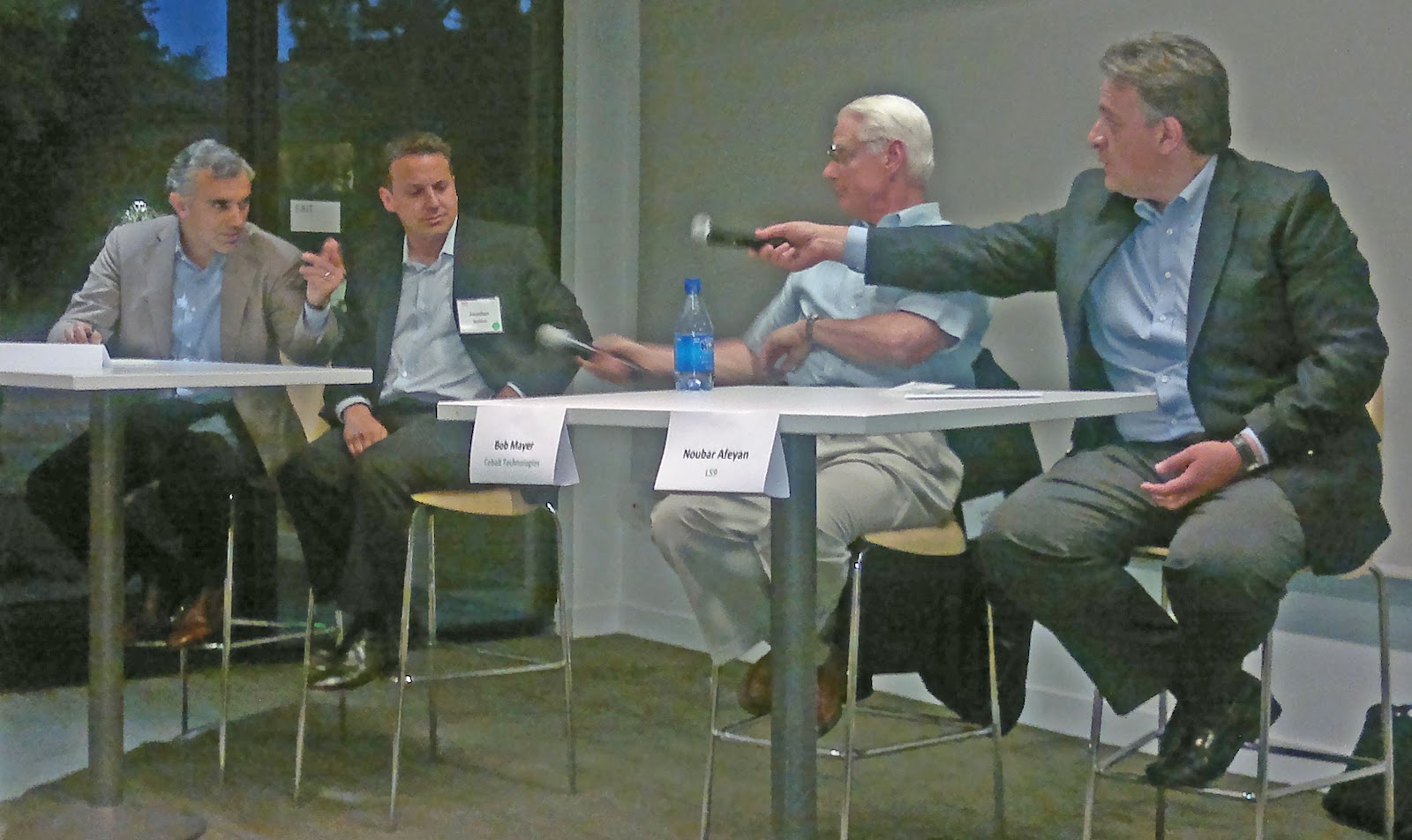
A capacity crowd of more than 100 people heard John Melo (CEO of Amyris), Jonathan Wolfson (CEO and co-founder of Solazyme), Bob Mayer (CEO of Cobalt) and Noubar Afeyan (a VC who is chairman and co-founder of LS9, Midori and Joule) discuss the industry. As the organizer of the event, I was pleased to hear that it was the first time all four had spoken together.

As CEOs of two of a handful of public biofuels companies, Melo and Wolfson have often been paired and seemed ready to complete each other’s sentences; both had just come off earnings calls — Solazyme on Monday and Amryis on Tuesday. For the MIT alumni, it was gratifying to hear that the other two men, Mayer and Afeyan, had doctorates in chemical engineering from MIT, and in fact Afeyan noted his 1987 dissertation was on converting cellulose to ethanol.

The four had a largely convergent view of the business and technical environment. The clear reality is that not having scale or huge balance sheets to fund ramping up to scale, the firms need to be nimble in arbitraging opportunities to more cost-effectively produce commodities that are needed by the market.

However, each emphasized a different approach to making money in that environment:
  • Melo said Amryis is engineering microbes (i.e. yeast) to convert carbohydrates into high-value chemicals. Because of his four years at BP USA — which included squeezing small ethanol plants that lacked their own distribution — he’s convinced that any path to success includes vertical integration.
  • Wolfson quoted Solazyme’s tagline that “we convert low cost plant sugars to high value renewable oils – for fuel, for food, for life.” The emphasis was on technical flexibility that allows creating oils for blending that are in regulatory favor — such as rapeseed oil in Europe.
  • For Cobalt, Mayer said the goal is to ferment hemicellulose to butanol — such as from sugar cane bagasse — without distributing the sugar production. The company hopes to exploit an secular trend in butanol prices rising faster than oil prices, at the same time that natural gas prices fall.
  • As managing director of Flagship Ventures, Afeyan has funded a number of biofuels startups, starting in 2003 with Mascoma that was converting cellulose to ethanol using the same organism (clostridium) that Afeyan studied in his PhD dissertation. He outlind the technologies of three of his companies: LS9 (engineering e-coli to create fatty alcohols), Midori Renewables (using a solid catalyst to degrade cellulose to produce sugar at 1/4 of current prices) and Joule (which would use cyanobacteria to directly convert CO2 to n-alkanes).
Afeyan aptly summed up the challenge of biofuels (and other tech entrepreneurs) when he said that entrepreneurs were chasing “what is not yet known not to work.”
MITCNC panelists (left to right): John Melo, Jonathan Wolfson, Bob Mayer and Noubar Afeyan
A major theme of the industry was partnering — for access to capital, distribution and (presumably) ultimate exit.

Noting a parallel to the funding of the biotech industry by oil and chemicals 30 years, Afeyan wondered when the CEO of the big oil and chemical companies will take a real interest in biofuels (rather than “just run nice ads”).

Mayer held out Dupont as an example of a company that “gets it.” Each of the CEOs had their own key partners. For Amyris it’s Total (a French oil company), for Solazyme it includes Dow, and Cobalt is partnered with Solvay/Rhodia, a specialty chemical company based on Brazil.

Not surprising for an industry that produces commodities (even high value one), the three CEOs repeatedly talked about execution. From his own career, Mayer said “industrial biotechnology is very much about execution.” Melo said the industry needed to “industrialize the process of developing the technology,” much as the biotech industry succeeded in doing. Meanwhile, Wolfson said success for a biofuels company — as with any other innovative Silicon Valley company — was about continuously innovating and creating new technologies to keep ahead of other companies.

The two public company CEOs were very wary of the unpredictable nature of government incentives. As Melo, “the US doesn’t care about long term strategic issues.” He questioned whether the Federal Renewable Fuel Standard will be around in five years, while Wolfson worried about the variability and arbitrary changes in life cycle carbon estimates — whether by private methodologies (such as LCA) or from state or Federal regulators such as the California Air Resources Board.

The challenge for the firms — and the investors — is that building a biofuels industry will take years, with many shifts of market and regulatory forces along the way. Melo said it took John D. Rockefeller 30 years to make oil a successful transportation fuel — although he hopes that biofuels can make it in 15 years. In the meantime, he said the first priority of any firm to generate revenues and cash flow to stick around. Or as Wolfson said, “In order to be involved in a commodity market, you need to be around long enough to get there.”

In the meantime, Melo predicted the next 24 months will bring consolidations and exits for many companies. I am inclined to agree: it probably won’t be as brutal as solar — where there are more companies — but clearly firms without positive cash flow (or at least solid balance sheets) will find it increasingly difficult to get the capital necessary, particularly as the IPO market appears to have closed for biofuels companies.

Saturday, April 28, 2012

What is the least bad RE?

On Thursday I started my course on renewable energy at San Jose State. As far as I know this is the first time EE/RE has been covered in the College of Business, and is the net result of the SJSU Solar Workforce Project (July 2010 - June 2012) funded by the state of California and the Green Innovation Challenge.

One of the questions I asked students was: which renewable energy is least bad? For “bad” I meant expensive, less useful, technically infeasible or other issues. (We didn’t bother to do this with coal and other fossil fuels because I’d already covered those issues in the opening lecture).

Everyone had a preferred energy source, but then the others in the room shot holes in it.

First up was biofuels. Biofuels are scalable, but they tend to divert agricultural land from food production (or divert food from eating to energy production) and thus increase the price of food. They also deplete the soil.

Next up was solar. It’s a great way to produce RE, but the most capital intensive energy generation approach available. It also ties up land (in some parts of the country, at least) that has other valuable use. And if the panels are made with CdTe or other toxic chemicals, you have to do something with them.

Wind — like solar — has a storage problem. Like utility scale solar, and coal, there are often transmission line costs and losses from the location where the wind exists (e.g. from the Midwest back to the Northeast). Its time of day generation is unpredictable. It also has its problems obstructing the views of locals and killing birds.

To me, hydro seemed like the no brainer — it's the lowest capital cost of any RE, with a proven technology. Unlike solar and wind, it allows generation when power is needed rather than when the energy is available. However, as a student from Pakistan pointed out, installing a dam by definition floods existing lands, and can displace farmers and villagers from their existing locations. (She also note that as with other water claims, the upstream choices for hydro generation impacts the hydro generating options downstream).

I don’t know why I forgot about the environmental impact of dams. The most notorious case in California is the Hetch Hetchy Valley in Yosemite National Park. Some 90 years ago, John Muir (and now the Sierra Club) fought unsuccessfully to keep San Francisco from flooding the Sierra mountain valley that Muir argued was every bit as beautiful as the Yosemite Valley.

At first glance, this might be a depressing conclusion. But the reality is that unless we want to go back to the horse and buggy, our economy requires energy. Life is full of tradeoffs, and a key theme of the course is using tools of economic analysis to optimize the allocation of scarce public or private resources to achieve environmental (or other) goals.

Sunday, April 22, 2012

All-star biofuels panel May 8

On May 8, I will be emcee for an all-star biofuels panel that I’ve been working for the past 5 months to organize. We will have under one roof the top execs of four of the Bay Area’s leading biofuels companies, at a panel discussion sponsored by the MIT Club of Northern California and its “Energy & Clean Tech Series.”

In alphabetical order, we have confirmed:
  • Noubar Afeyan – Chairman and co-founder, LS9
  • Bob Mayer – CEO and Chairman, Cobalt Technologies
  • John Melo – CEO, Amyris
  • Jonathan Wolfson - CEO and co-founder, Solazyme
These represent three of the five top companies in the Biofuels Digest Top 50 list of US biofuels companies: Solazyme (#1), Amyris (#2), LS9 (#5). The first two of these companies are among 13 publicly traded firms in the Biofuels Digest Index.

Meanwhile, Wolfson, Melo and Mayer are among the Biofuels Digest “Top 100 People in Bioenergy.” Wolfson and Melo are #5 and #6 on the list, after the secretary of agriculture, two BP execs, a Brazilian CEO and the CEO of Sioux Falls-based Poet. Both Melo and Mayer have decades of oil and chemical industry experience, with BP (Melo) and Danisco (Mayer).

Noubary Afeyan is different from the others: rather than an operating role at LS9, he is the managing partner (and founder) of Flagship Ventures. Based in Boston, he lists co-founding roles for 24 life science and technology startups.

I had lots of help from Jim Lane, editor of Biofuels Digest, who thought it an impressive panel when we only had three names. This will be the first opportunity for most Bay Area cleantech investors, employees and aficionados to see all these executives under one roof. Given the technology overlaps between biotech and biofuels, we’re also hoping to attract employees (and MIT alumni) from local biotech firms.

The event is hosted by Orrick, Herrington & Sutcliffe, and our moderator is Don Keller, a senior partner and a member of the firm’s board of directors. As organizer, I will provide a brief background on the industry and then turn it over to Don to introduce our panelists and moderate the discussion and audience Q&A.

The event (which includes dinner and networking) runs from 6:00-9:00 p.m. at Orrick’s Silicon Valley offices in Menlo Park. Advance registration is requested.

Friday, April 6, 2012

Oil and biofuel companies as 'frenemies'

Reuters highlights the cooperative and competing interests of biofuels companies and traditional oil companies in an article entitled “Oil, biofuel companies evolve into uneasy ‘frenemies’.”

The term is attributed to my friend Jim Lane, the biofuel industry’s most influential journalist:
“They're kind of ‘frenemies,’” said Jim Lane, publisher of the Biofuels Digest, noting the two sides have worked together at times and been at odds on other occasions.
The friend part is easy: oil companies are buying and partnering with bioufels companies and also making their internal investments. The article mentions acquisitions by BP, partnership by Chevron and internal investments by Exxon. This is what we in b-schools call a natural complementarity: oil companies have distribution and capital, while biofuels companies have a new product that may become more desirable than the existing one. Big Pharma and biotech companies have enjoyed the benefits of such complementarities for almost 30 years.

Jim Lane highlighted another example of such collaboration in his report Thursday from the Advanced Biofuels Leadership Conference, on a talk by Philip New, head of BP Biofuels:
Even for long-time observers or supporters of alternative energy, it is a startling thing to hear a division head at an oil major, presiding over a duchy consisting of upstream energy assets in the UK, US and Brazil and having 4,000 employees in his care – talking in terms of becoming an owner-operator of energy assets in Brazil. Making the decision to take on agricultural risk and operate beyond proxies like joint ventures.

And, most startling of all, leading the call for the preservation of the US Renewable Fuels Standard, or RFS2.

Weren’t the opponents of RFS2 supposed to include the incumbent oil majors? Weren’t they the forces of “drill, baby, drill”?
Meanwhile, some of the “enemy” claims by the Reuters author are just silly:
Oil companies have long been skeptical of the economics of corn-based ethanol, once derided by Exxon Mobil CEO Rex Tillerson as "moonshine," as well as federal rules that called for the fuel to make up as much as 10 percent of the gasoline supply.
In other words, widespread reporting about the impacts of corn ethanol upon food prices are a plot by Big Oil to sabotage the biofuels industry. By this definition, Bill Clinton and Al Gore are part of some vast right wing conspiracy.

Other aspects of the “enemy” perception are populist attempts to create an enemy:
"You're faced with a very well-financed group of people who don't necessarily want this industry," Agriculture Secretary Tom Vilsack told the Advanced Biofuels Leadership Conference this week.
In other words, the difficulties of the biofuels industry are not due to unproven technologies and difficulties competing with inexpensive and proven commodities, but due to some conspiracy by evil Big Oil. (About what you’d expect from a small town lawyer and politician.)

True, the American Petroleum Institute did sue last month to block the cellulosic fuel mandate in the Renewable Fuel Standard.
“EPA’s standard is divorced from reality and forces refiners to purchase credits for cellulosic fuels that do not exist,” said API Director of Downstream and Industry Operations Bob Greco. “EPA’s unrealistic mandate is effectively a tax on manufacturers of gasoline that could ultimately burden consumers.”
The online magazine Ethanol Producer helpfully explained:
API filed requests with the EPA in 2011 and in early 2012 asking it to reconsider the cellulosic biofuel volume mandate. According to API, the EPA has not responded to either request which is why the group has elected to file a lawsuit on the matter. Ultimately, the group would prefer a cellulosic volume mandate that is based on two months of proven production rather than on anticipated production levels. The EPA has repeatedly stated in its final rules on cellulosic volumes, however, that it believes it should be optimistic when determining cellulosic volume requirements in order to provide incentive for growth in an emerging industry.
Unfortunately, the energy industry faces a chicken-and-egg problem: the problem of scaling to produce cost-effective substitutes for traditional energy requires massive investments in R&D and capital, which are too risky to be made without a subsidy or mandate. As Philip New noted, Brazil’s efforts to shift energy supply took more than 20 years. (The alternative is to wait for oil to hit $200/barrel and then spend decades trying to address the problem).

Still, the country would be far better served by having a technology-neutral RFS policy that incentivized any approach that didn’t displace farmland for fuel. As in the renewable electricity mandates (e.g., California’s Renewable Portfolio Standard), the government should harness the market to encourage investment in the most promising and cost-effective technologies. Or as a Purdue professor wrote in a 2010 critique of US biofuels policy:
A technology- and feedstock-neutral policy is clearly preferred to one in which”the government weighs in heavily on technology choice.
A centrist president might be able to initiate a policy that encouraged scaling up biofuels production without subsidizing any specific technology. That would include modifying RFS to be more technology-neutral, to allow algae and other feedstocks that can be grown on barren land in the Southwest and Southeast.

Tuesday, February 28, 2012

MIT: how to integrate more renewables

The MIT Energy Initiative is holding a free webinar March 12, broadcast from a live seminar at MIT. The event will discuss the results of the MITEI symposium on how to leverage renewable power sources without relying on storage:
Briefing on the Final Report of the Symposium on Managing Large-Scale Penetration of Intermittent Renewables
Monday, March 12, 2012 12:00 PM - 2:00 PM (Eastern Time)

The focus of the symposium was on how renewable energy standards affect power system capacity planning and operations, assuming affordable, scalable electricity storage options will not be available for at least a decade, and probably more. Until such breakthroughs materialize, capacity planning and implementation are still required.

Currently, 29 US states and 27 EU countries have renewable energy standards. As countries increasingly embrace intermittent renewable resources, they will confront the operational challenges this poses for baseload power generation and generators. The results of the symposium, including commissioned white papers and other submitted technical papers, will be included in the report that will be available at the event.
The website for the April 2011 symposium has nearly 30 papers or presentations about how to combine renewable energy with traditional sources to level out electricity supplies — in lieu of relying solely on baseload generation.

I am looking forward to the presentation, which I hope will discuss the forest rather than the trees. Trying to make sense of the papers individually seems like trying to understand a forest from its constiuent leaves and twigs.

In looking up the earlier symposium, I also ran across another MIT study released in December that looks at the impact of renewable energy generation upon the electricity distribution grid. This MIT team concluded that federal preemption is the only way the US will get enough transmission lines necessary to carry this renewable energy.

The MIT press release quotes the study director, former Sloan School dean Dick Schmalensee:
While the grid is not in any imminent danger, he says, “the current regulatory framework, largely established in the 1930s, is mismatched to today’s grid.” Moreover, he adds, today’s regulations are “highly unlikely [to] give us the grid of the future — a grid that by 2030 will support a range of new technologies and consumer services that will be essential for a strong and competitive U.S. economy.”

While the grid’s performance is adequate today, decisions made now will shape that grid over the next 20 years. The MIT report recommends a series of changes in the regulatory environment to facilitate and exploit technological innovation. Among the report’s specific recommended changes: To enable the grid of the future — one capable of handling intermittent renewables — the United States will need effective and enhanced federal authority over decisions on the routing of new interstate transmission lines. This is especially needed, the report says, in cases where power is produced by solar or wind farms located far from where that power is to be used, requiring long-distance transmission lines to be built across multiple regulatory jurisdictions.

“It is a real issue, a chicken-and-egg problem,” says John Kassakian, a professor of electrical engineering at MIT and the study’s other co-chair. “Nobody’s going to build these new renewable energy plants unless they know there will be transmission lines to get the power to load centers. And nobody’s going to build transmission lines unless the difficulty of siting lines across multiple jurisdictions is eased.”

Currently, when new transmission lines cross state boundaries, each state involved — and federal agencies as well, if federal lands are crossed — can make its own decisions about permission for the siting of these lines, with no centralized authority.

“There are many people who can say no, and nobody who can say yes,” Schmalensee explains. “That’s strategically untenable, especially since some of these authorities would have little incentive ever to say yes.”
In other words, the MIT technocrats concluded that we need a national policy to address the NIMBY problems that have plagued both solar farms and distribution grids in California. It sounds like a good idea, but (as in the the solar farm example) requires resolving the conflict between RE-loving environmentalists and NIMBY environmentalists.

Sunday, February 19, 2012

The cost of German solar policies

Bjørn Lomborg is a controversial PhD political scientist who has questioned the cost effectiveness of various efforts to mitigate global warming.

His Feb. 16 syndicated commentary discusses the implications of Germany’s plans to drastically scale back its feed-in-tariff:
Germany’s Sunshine Daydream
By Bjørn Lomborg

Germany once prided itself on being the “photovoltaic world champion”, doling out generous subsidies – totaling more than $130 billion, according to research from Germany’s Ruhr University – to citizens to invest in solar energy. But now the German government is vowing to cut the subsidies sooner than planned, and to phase out support over the next five years. What went wrong?

There is a fundamental problem with subsidizing inefficient green technology: it is affordable only if it is done in tiny, tokenistic amounts. Using the government’s generous subsidies, Germans installed 7.5 gigawatts of photovoltaic (PV) capacity last year, more than double what the government had deemed “acceptable.” It is estimated that this increase alone will lead to a $260 hike in the average consumer’s annual power bill.

On short, overcast winter days, Germany’s 1.1 million solar-power systems can generate no electricity at all. The country is then forced to import considerable amounts of electricity from nuclear power plants in France and the Czech Republic. When the sun failed to shine last winter, one emergency back-up plan powered up an Austrian oil-fired plant to fill the supply gap.

Indeed, despite the massive investment, solar power accounts for only about 0.3% of Germany’s total energy. This is one of the key reasons why Germans now pay the second-highest price for electricity in the developed world (exceeded only by Denmark, which aims to be the “world wind-energy champion”). Germans pay three times more than their American counterpart.

Using solar, Germany is paying about $1,000 per ton of CO2 reduced. The current CO2 price in Europe is $8. Germany could have cut 131 times as much CO2 for the same price. Instead, the Germans are wasting more than 99 cents of every euro that they plow into solar panels.

It gets worse: because Germany is part of the European Union Emissions Trading System, the actual effect of extra solar panels in Germany leads to no CO2 reductions, because total emissions are already capped. Instead, the Germans simply allow other parts of the EU to emit more CO2. Germany’s solar panels have only made it cheaper for Portugal or Greece to use coal.

In the meantime, Germans have paid about $130 billion for a climate-change policy that has no impact on global warming. They have subsidized Chinese jobs and other European countries’ reliance on dirty energy sources. And they have needlessly burdened their economy. As even many German officials would probably attest, governments elsewhere cannot afford to repeat the same mistake.

Friday, January 20, 2012

Better ways to spend $100 billion

The $100 billion, 22-year projected cost of the proposed California High Speed Rail system should be enough to kill it. But this week, Governor Brown vested his full support — and personal credibility — in this project, hoping to persuade (or overrule) the sentiments of a majority of the state’s voters.

I am a transit fan, second to none. I spent college taking pictures of mass transit systems in Boston, Washington and San Francisco. The one success of my (brief) career as a UPI photo stringer was a picture of the inauguration of the San Diego Trolley that ran on the front page of the San Diego Union. I’ve ridden high speed trains in Japan and Europe, including the Eurostar from Brussels to London. And — unlike most Americans — I’ve even taken cross-country Amtrak trains overnight, both with and without a sleeping car.

Still, $100 billion is a lot of money for one state to cover. That’s assuming that the system could be built for this price, even though major public works projects always run over budget (cf. the “Big Dig”).

Even if an electric train generates less pollution than an internal combustion engine car, is it necessary to put down a $100 billion bet that the system will be economically viable?

Charles Lane of the Washington Post thinks not:
On the merits, high-speed rail would be a questionable investment even if California could afford to build it.

…[B]oosters marvel at bullet trains in Europe and Japan, insisting simplistically that we need them, too.

But the sprawling, decentralized cities of the United States do not make convenient destinations for train travelers. International experience shows that high-speed rail entails expensive debt service and large operating subsidies. This would likely be the case here as well, since, for better or worse, rail must compete with well-established air and car options. Business travel is one ostensible purpose of bullet trains in California, but increasingly people meet via video conference.

For these and other reasons, high-speed rail in the United States would lower carbon emissions and reduce traffic far less cost-effectively than would alternative solutions.
In the past decade, videoconferencing has made huge strides in replacing business travel. No transit system — in fact, nothing short of teleportation — is going to be able to compete with videoconferencing for efficient use of time for short meetings.

Meanwhile, as Lane says, are there budget priorities that could improve the state’s environment far more cost-effectively? The California Solar Initiative is a $3.35 billion cross-subsidy (1/30th the cost of the CHSR) by electricity users that has already brought the installation of more than 1 gigawatt of renewable energy capacity for the state.

Monday, January 16, 2012

In Memoriam: 2011 solar shakeout victims

As part of updating a research paper I’m writing on solar policy, I’ve been catching up on the state of the solar business. (Regular readers will note that since I joined KGI, I’ve been paying a lot more attention to biofuels).

To start, I thought I’d look at all the solar firms that died (or otherwise were mortally wounded) in 2011. I traced down the announcements of the firms mentioned in various stories, and here is what I found:
Company
HQ
Stock
Tech-nology
Date
Action
Current Status
SoliantMonrovia, CAprivateCPVMar. 29LiquidatedLiquidated for 1.5¢ on the dollar
EvergreenMarlboro, MAESLRribbon SiAug. 15Chapter 11Liquidated
SpectraWattHopewell Junction, NYprivateSiAug. 19Chapter 11In liquidation
SolyndraFremont, CAprivatethin film (CIGS)Aug. 31Chapter 11Liquidated
Stirling Energy SystemsScottsdale, AZprivatethermal (Stirling engine)Sep. 23Chapter 7In liquidation
Solon AGBerlin, GermanySOO1.FSiDec. 13InsolvencySeeking a buyer
BP SolarUK(division of BP)SiDec. 20Announced plans to closeWinding down
Solar Millennium AGErlangen, GermanyS2M.FCSP & PV solar farmsDec. 21InsolvencySelling solar farm projects

Most of these were solar system manufacturers, making panels, tubes (Solyndra) or stand-alone thermal generating dishes (Stirling). The mainstream companies (like SpectraWatt) might have IP that’s useful for other PV companies, while the oddball companies (Evergreen, Solyndra, Stirling) had unique technologies of little or no value to other firms.

BP Solar’s decision to get out of PV marks the latest realization by oil companies that biofuels (not solar) fit their existing business model. I hope to blog on this another time.

Solar Millennium is unique in that it was a large solar farm developer, and thus its projects (if they still make economic sense) might be bought by other companies. One of its largest projects is the 1 gigawatt Blythe Solar Power Project that won a $2.1 billion loan guarantee from the DEO and was praised by DOE Secretary Steven Chu and California governor Jerry Brown. It appears that the Blythe and other US projects are being sold by Solar Millennium’s majority owned US subsidiary to SolarHybrid AG.

Friday, November 4, 2011

Biofuels from 5000'

Biofuels are being used at 30,000' as airlines (and aircraft manufacturers) explore options for growing rather than drilling for Jet A feedstock. (They will actually be used at much higher altitudes if the DoD’s efforts to develop bio-JP5 and JP8 for military aircraft bear fruit.)

However, this week I gave a 5,000' overview of the biofuel industry to first year students at KGI, the Keck Graduate Institute of Applied Life Sciences. Although our college is primarily oriented towards biotech and big pharma, there is a substantial pocket of interest in biofuels.

The one hour talk was intended to help students understand the various economic, technical, and political issues regarding biofuels. It started with an overview of US energy usage, and the factors driving interest in renewable energy in the 1970s and today. It reminded students — some of whom are in their first semester of business classes — that preferences for commodities like energy are usually driven by price.


Even more so than solar, biofuels compete directly with oil. As a nice chart from oilism.com illustrates, the big issue is that across the past 40 years, almost every attempt to predict oil prices from the past has failed.
I still need to understand the technology better. My students are helping me learn more here, since our grad students with undergrad biochemistry or chemical engineering majors know far more about the science than I do. (Some of them are leveraging this expertise to get internships and jobs in the industry.)

In pulling together the talk, the one thing that was striking was how dependent the industry is today on policy. For example, on Wednesday Jim Lane of Biofuels Digest listed the 10 hottest topics facing the biofuels industry today — of which only four (or five) are under the control of private industry:
  1. RFS. Hold or Fold? Critics want to scrap the Renewable Fuel Standard.
  2. Can Obama find the $510 million? The DOE, USDA and US Navy each pledged $170 million toward scale-up funding of advanced biofuels, for defense purposes. …
  3. Elections. … Numerous Republican candidates … have decided to oppose ethanol subsidies.
  4. Fuels, or chems, or something else? There’s been such a proliferation this year in target products, it hardly seems apt to call this publication Biofuels Digest anymore. …
  5. The EPA’s attitude on waivers. WIll the EPA continue to enforce the RFS mandate for advanced biofuels based on production capacity …
  6. RIN prices. Ethanol RINs remain at prices so low they hardly matter, but biodiesel RINs have been on a roller coaster…
  7. BRICs and mortar. [interest in BRIC countries.]
  8. Freshwater, arable land, potassium, phosphorus, nitrogen. … what about the looming shortages in freshwater, and nutrients such as phosphorus?
  9. Feedstock development. … Where is all the low-cost camelina, jatropha, algae and so on? …
  10. Money. … [As Phycal’s Kevin Berner said, “at scale, any advanced biofuels project is a capital pig.” For $100 million, you can finance maybe 20 strong pilots
At KGI, we’ve had two biofuels speakers so far this year, and expect another 3 or 4 before the year is out. I’m sure we’ll have more to report in the coming months.