/* Google Analytics */
Showing posts with label biofuels. Show all posts

Thursday, November 1, 2012

Are biofuels doomed without subsidies?

A molecular biologist (turned biofuels entrepreneur) made a stark prediction Tuesday:
Famed genomics researcher J. Craig Venter, who is working to develop biofuels from photosynthetic algae, acknowledged this week that alternate fuels are “dead” unless the federal government mandates their use with a carbon policy.

Venter’s strongly worded statement came Tuesday night at the annual Stem Cell Meeting on the Mesa, after he was asked when synthetic biology might have a meaningful impact on the country’s energy production.

Without strong government intervention, Venter said, that day will never come. He works on biofuels, human health and other issues at Synthetic Genomics, the La Jolla company he co-founded. It partnered with ExxonMobil in 2009 to develop algae biofuels.

“It doesn’t matter what the scientific breakthroughs are, there’s no way to ever beat oil,” Venter said. “In fact, oil’s not even an issue right now because of all the new natural gas discoveries.

“So there’s no way economically for a new fuel made out of renewables to ever be able to compete with something an oil company can do, without sharp federal regulations and a sharp carbon policy that says, you can’t keep just taking carbon out of the ground, burning it and putting it in the atmosphere. Until we do that, there is no biofuel industry.”
Venter is no stranger to big bets (or government intervention). His Celera Genomics raced the NIH (and its Human Genome Project) to sequence the first human genome, which cost several billion dollars.

Now Venter is hoping for government intervention — implying a carbon tax on natural gas and other fossil fuels — to raise their cost enough to support synthetic biofuels.

However, the story by life sciences reporter Bradley Fikes suggests that the key problem is not subsidies (or taxes on competing technologies) — in part because taxes on oil would reduce demand and thus prices. Fikes quoted Berkeley energy economist Severin Borenstein:
Regulatory mandates to compel adoption of biofuels probably wouldn’t work, Borenstein said.

“It may work for the United States, and even that seems a political stretch, but it doesn’t really matter if it doesn’t work in the developing world,” he said. “The idea that the developing world is going to forgo cheap gasoline to use much more expensive biofuels, I think is fairly implausible for the near term.”

Science may provide answers in the long term, he said.

“I’ve come around to the view that we need to put a lot more into research and development and pursue every possibility, whether it’s biofuels or electric vehicles, in order to find something that could be cost-competitive,” Borenstein said.
The latter point suggests one of the major disconnects in the biofuels world, between the energy industry veterans who work in the market and the university molecular biologists who are used to NIH and NSF funding all their research. Is it time for biofuels to go back to being a series of university science experiments rather than being the basis of publicly-traded high-tech startups?

Saturday, May 12, 2012

Video for all-star biofuels panel

The video from Tuesday’s MITCNC biofuels panel discussion has been posted to MIT’s video channel, TechTV.

For those who were not in Menlo Park, here is the program:


Biofuels:
How Biotech is Changing the Energy Industry

Panelists
John Melo – CEO, Amyris
Jonathan Wolfson - CEO, Solazyme
Bob Mayer – CEO, Cobalt Technologies
Noubar Afeyan – Chairman, LS9

Moderator
Don Keller – Partner, Orrick Herrington & Sutcliffe

May 8, 2012
Orrick, Herrington & Sutcliffe LLP
1000 Marsh Rd
Menlo Park, CA 95025

Participant biographies:

John Melo is CEO of Amyris. Before that, he was president of US Fuels for BP Plc, where built up its ethanol blending business. He serves on the board of Kior and US Venture and previously served ass a director at Ernst & Young in San Jose.

Jonathan Wolfson is CEO and co-founder of Solazyme. He previously served as co-founder and COO of InvestorTree. He is a director of the Clean Economy Network and the Biotechnology Industry Organization. He holds a JD and MBA from NYU.

Bob Mayer is CEO and chairman Cobalt Technologies. His experience in biotechnology includes president of Genencor International and Danisco USA. He holds a ScD in Chemical Engineering from MIT, and was an assistant professor in MIT’s chemical engineering department.

Noubar Afeyan is managing partner and CEO of Flagship Ventures, and is co-founder and chairman of three biofuels companies: LS9, Joule and Midori. He holds a PhD in Chemical Engineering from MIT and serves as a Senior Lecturer at the Sloan School.

Moderator Don Keller is a partner at Orrick, Herrington & Sutcliffe LLP, where he is one of the firm’s 11-member board of director and has advised clients on more than 60 IPOs. He holds a JD from Boston College Law School and serves on its Board of Overseers.

Emcee Joel West is a professor at the Keck Graduate Institute of Applied Life Sciences, one of the Claremont Colleges. He holds a PhD from UC Irvine and a SB from MIT.

Wednesday, May 9, 2012

State of the US biofuels industry

On Tuesday, the MIT alumni club in Silicon Valley hosted a freewheeling discussion by four executives from leading US biofuels companies, discussing the opportunities and challenges of building a new industry from scratch.

Update May 12: The video and program have been posted.

A capacity crowd of more than 100 people heard John Melo (CEO of Amyris), Jonathan Wolfson (CEO and co-founder of Solazyme), Bob Mayer (CEO of Cobalt) and Noubar Afeyan (a VC who is chairman and co-founder of LS9, Midori and Joule) discuss the industry. As the organizer of the event, I was pleased to hear that it was the first time all four had spoken together.

As CEOs of two of a handful of public biofuels companies, Melo and Wolfson have often been paired and seemed ready to complete each other’s sentences; both had just come off earnings calls — Solazyme on Monday and Amryis on Tuesday. For the MIT alumni, it was gratifying to hear that the other two men, Mayer and Afeyan, had doctorates in chemical engineering from MIT, and in fact Afeyan noted his 1987 dissertation was on converting cellulose to ethanol.

The four had a largely convergent view of the business and technical environment. The clear reality is that not having scale or huge balance sheets to fund ramping up to scale, the firms need to be nimble in arbitraging opportunities to more cost-effectively produce commodities that are needed by the market.

However, each emphasized a different approach to making money in that environment:
  • Melo said Amryis is engineering microbes (i.e. yeast) to convert carbohydrates into high-value chemicals. Because of his four years at BP USA — which included squeezing small ethanol plants that lacked their own distribution — he’s convinced that any path to success includes vertical integration.
  • Wolfson quoted Solazyme’s tagline that “we convert low cost plant sugars to high value renewable oils – for fuel, for food, for life.” The emphasis was on technical flexibility that allows creating oils for blending that are in regulatory favor — such as rapeseed oil in Europe.
  • For Cobalt, Mayer said the goal is to ferment hemicellulose to butanol — such as from sugar cane bagasse — without distributing the sugar production. The company hopes to exploit an secular trend in butanol prices rising faster than oil prices, at the same time that natural gas prices fall.
  • As managing director of Flagship Ventures, Afeyan has funded a number of biofuels startups, starting in 2003 with Mascoma that was converting cellulose to ethanol using the same organism (clostridium) that Afeyan studied in his PhD dissertation. He outlind the technologies of three of his companies: LS9 (engineering e-coli to create fatty alcohols), Midori Renewables (using a solid catalyst to degrade cellulose to produce sugar at 1/4 of current prices) and Joule (which would use cyanobacteria to directly convert CO2 to n-alkanes).
Afeyan aptly summed up the challenge of biofuels (and other tech entrepreneurs) when he said that entrepreneurs were chasing “what is not yet known not to work.”
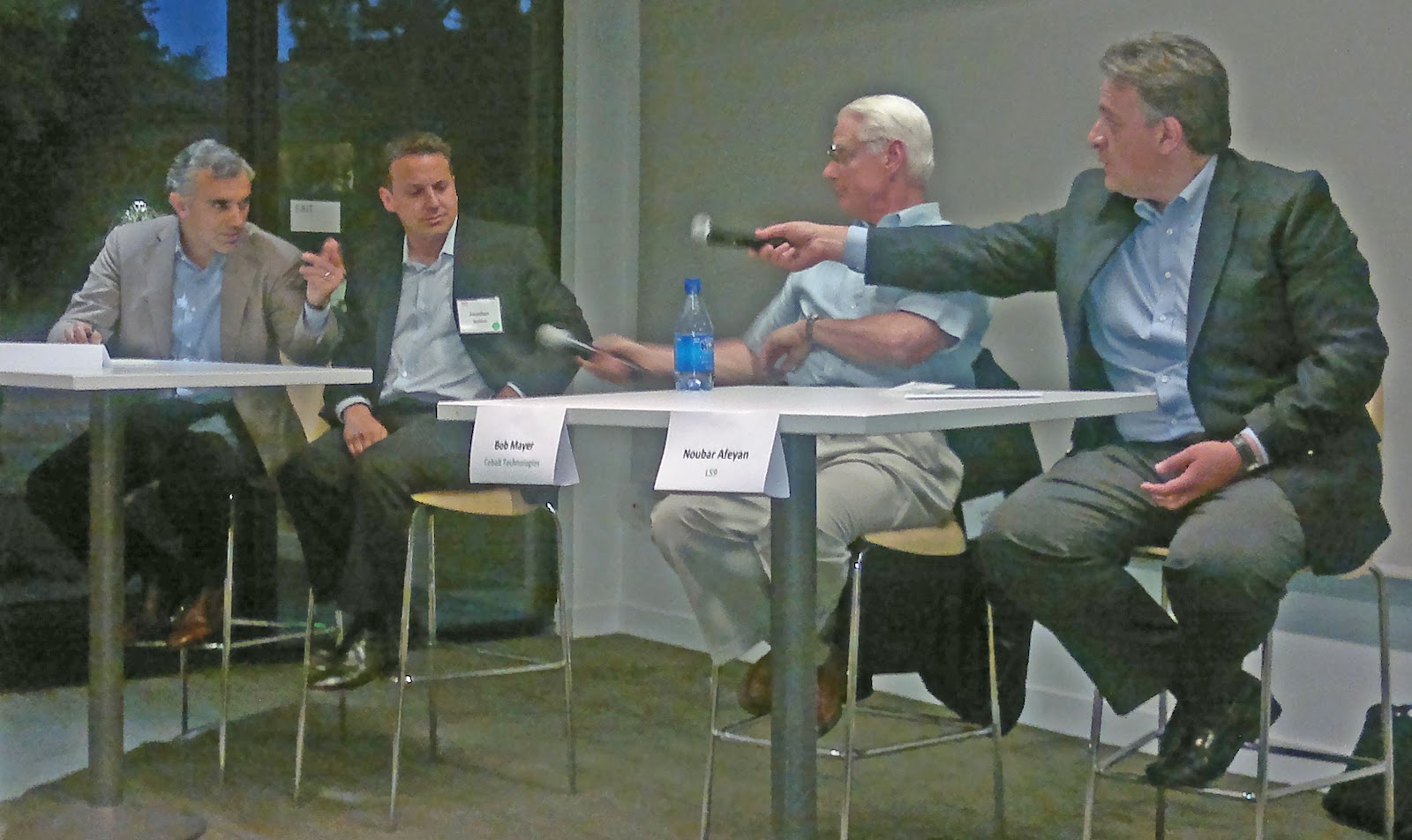
MITCNC panelists (left to right): John Melo, Jonathan Wolfson, Bob Mayer and Noubar Afeyan
A major theme of the industry was partnering — for access to capital, distribution and (presumably) ultimate exit.

Noting a parallel to the funding of the biotech industry by oil and chemicals 30 years, Afeyan wondered when the CEO of the big oil and chemical companies will take a real interest in biofuels (rather than “just run nice ads”).

Mayer held out Dupont as an example of a company that “gets it.” Each of the CEOs had their own key partners. For Amyris it’s Total (a French oil company), for Solazyme it includes Dow, and Cobalt is partnered with Solvay/Rhodia, a specialty chemical company based on Brazil.

Not surprising for an industry that produces commodities (even high value one), the three CEOs repeatedly talked about execution. From his own career, Mayer said “industrial biotechnology is very much about execution.” Melo said the industry needed to “industrialize the process of developing the technology,” much as the biotech industry succeeded in doing. Meanwhile, Wolfson said success for a biofuels company — as with any other innovative Silicon Valley company — was about continuously innovating and creating new technologies to keep ahead of other companies.

The two public company CEOs were very wary of the unpredictable nature of government incentives. As Melo, “the US doesn’t care about long term strategic issues.” He questioned whether the Federal Renewable Fuel Standard will be around in five years, while Wolfson worried about the variability and arbitrary changes in life cycle carbon estimates — whether by private methodologies (such as LCA) or from state or Federal regulators such as the California Air Resources Board.

The challenge for the firms — and the investors — is that building a biofuels industry will take years, with many shifts of market and regulatory forces along the way. Melo said it took John D. Rockefeller 30 years to make oil a successful transportation fuel — although he hopes that biofuels can make it in 15 years. In the meantime, he said the first priority of any firm to generate revenues and cash flow to stick around. Or as Wolfson said, “In order to be involved in a commodity market, you need to be around long enough to get there.”

In the meantime, Melo predicted the next 24 months will bring consolidations and exits for many companies. I am inclined to agree: it probably won’t be as brutal as solar — where there are more companies — but clearly firms without positive cash flow (or at least solid balance sheets) will find it increasingly difficult to get the capital necessary, particularly as the IPO market appears to have closed for biofuels companies.

Sunday, April 22, 2012

All-star biofuels panel May 8

On May 8, I will be emcee for an all-star biofuels panel that I’ve been working for the past 5 months to organize. We will have under one roof the top execs of four of the Bay Area’s leading biofuels companies, at a panel discussion sponsored by the MIT Club of Northern California and its “Energy & Clean Tech Series.”

In alphabetical order, we have confirmed:
  • Noubar Afeyan – Chairman and co-founder, LS9
  • Bob Mayer – CEO and Chairman, Cobalt Technologies
  • John Melo – CEO, Amyris
  • Jonathan Wolfson - CEO and co-founder, Solazyme
These represent three of the five top companies in the Biofuels Digest Top 50 list of US biofuels companies: Solazyme (#1), Amyris (#2), LS9 (#5). The first two of these companies are among 13 publicly traded firms in the Biofuels Digest Index.

Meanwhile, Wolfson, Melo and Mayer are among the Biofuels Digest “Top 100 People in Bioenergy.” Wolfson and Melo are #5 and #6 on the list, after the secretary of agriculture, two BP execs, a Brazilian CEO and the CEO of Sioux Falls-based Poet. Both Melo and Mayer have decades of oil and chemical industry experience, with BP (Melo) and Danisco (Mayer).

Noubary Afeyan is different from the others: rather than an operating role at LS9, he is the managing partner (and founder) of Flagship Ventures. Based in Boston, he lists co-founding roles for 24 life science and technology startups.

I had lots of help from Jim Lane, editor of Biofuels Digest, who thought it an impressive panel when we only had three names. This will be the first opportunity for most Bay Area cleantech investors, employees and aficionados to see all these executives under one roof. Given the technology overlaps between biotech and biofuels, we’re also hoping to attract employees (and MIT alumni) from local biotech firms.

The event is hosted by Orrick, Herrington & Sutcliffe, and our moderator is Don Keller, a senior partner and a member of the firm’s board of directors. As organizer, I will provide a brief background on the industry and then turn it over to Don to introduce our panelists and moderate the discussion and audience Q&A.

The event (which includes dinner and networking) runs from 6:00-9:00 p.m. at Orrick’s Silicon Valley offices in Menlo Park. Advance registration is requested.

Friday, April 6, 2012

Oil and biofuel companies as 'frenemies'

Reuters highlights the cooperative and competing interests of biofuels companies and traditional oil companies in an article entitled “Oil, biofuel companies evolve into uneasy ‘frenemies’.”

The term is attributed to my friend Jim Lane, the biofuel industry’s most influential journalist:
“They're kind of ‘frenemies,’” said Jim Lane, publisher of the Biofuels Digest, noting the two sides have worked together at times and been at odds on other occasions.
The friend part is easy: oil companies are buying and partnering with bioufels companies and also making their internal investments. The article mentions acquisitions by BP, partnership by Chevron and internal investments by Exxon. This is what we in b-schools call a natural complementarity: oil companies have distribution and capital, while biofuels companies have a new product that may become more desirable than the existing one. Big Pharma and biotech companies have enjoyed the benefits of such complementarities for almost 30 years.

Jim Lane highlighted another example of such collaboration in his report Thursday from the Advanced Biofuels Leadership Conference, on a talk by Philip New, head of BP Biofuels:
Even for long-time observers or supporters of alternative energy, it is a startling thing to hear a division head at an oil major, presiding over a duchy consisting of upstream energy assets in the UK, US and Brazil and having 4,000 employees in his care – talking in terms of becoming an owner-operator of energy assets in Brazil. Making the decision to take on agricultural risk and operate beyond proxies like joint ventures.

And, most startling of all, leading the call for the preservation of the US Renewable Fuels Standard, or RFS2.

Weren’t the opponents of RFS2 supposed to include the incumbent oil majors? Weren’t they the forces of “drill, baby, drill”?
Meanwhile, some of the “enemy” claims by the Reuters author are just silly:
Oil companies have long been skeptical of the economics of corn-based ethanol, once derided by Exxon Mobil CEO Rex Tillerson as "moonshine," as well as federal rules that called for the fuel to make up as much as 10 percent of the gasoline supply.
In other words, widespread reporting about the impacts of corn ethanol upon food prices are a plot by Big Oil to sabotage the biofuels industry. By this definition, Bill Clinton and Al Gore are part of some vast right wing conspiracy.

Other aspects of the “enemy” perception are populist attempts to create an enemy:
"You're faced with a very well-financed group of people who don't necessarily want this industry," Agriculture Secretary Tom Vilsack told the Advanced Biofuels Leadership Conference this week.
In other words, the difficulties of the biofuels industry are not due to unproven technologies and difficulties competing with inexpensive and proven commodities, but due to some conspiracy by evil Big Oil. (About what you’d expect from a small town lawyer and politician.)

True, the American Petroleum Institute did sue last month to block the cellulosic fuel mandate in the Renewable Fuel Standard.
“EPA’s standard is divorced from reality and forces refiners to purchase credits for cellulosic fuels that do not exist,” said API Director of Downstream and Industry Operations Bob Greco. “EPA’s unrealistic mandate is effectively a tax on manufacturers of gasoline that could ultimately burden consumers.”
The online magazine Ethanol Producer helpfully explained:
API filed requests with the EPA in 2011 and in early 2012 asking it to reconsider the cellulosic biofuel volume mandate. According to API, the EPA has not responded to either request which is why the group has elected to file a lawsuit on the matter. Ultimately, the group would prefer a cellulosic volume mandate that is based on two months of proven production rather than on anticipated production levels. The EPA has repeatedly stated in its final rules on cellulosic volumes, however, that it believes it should be optimistic when determining cellulosic volume requirements in order to provide incentive for growth in an emerging industry.
Unfortunately, the energy industry faces a chicken-and-egg problem: the problem of scaling to produce cost-effective substitutes for traditional energy requires massive investments in R&D and capital, which are too risky to be made without a subsidy or mandate. As Philip New noted, Brazil’s efforts to shift energy supply took more than 20 years. (The alternative is to wait for oil to hit $200/barrel and then spend decades trying to address the problem).

Still, the country would be far better served by having a technology-neutral RFS policy that incentivized any approach that didn’t displace farmland for fuel. As in the renewable electricity mandates (e.g., California’s Renewable Portfolio Standard), the government should harness the market to encourage investment in the most promising and cost-effective technologies. Or as a Purdue professor wrote in a 2010 critique of US biofuels policy:
A technology- and feedstock-neutral policy is clearly preferred to one in which”the government weighs in heavily on technology choice.
A centrist president might be able to initiate a policy that encouraged scaling up biofuels production without subsidizing any specific technology. That would include modifying RFS to be more technology-neutral, to allow algae and other feedstocks that can be grown on barren land in the Southwest and Southeast.

Friday, November 4, 2011

Biofuels from 5000'

Biofuels are being used at 30,000' as airlines (and aircraft manufacturers) explore options for growing rather than drilling for Jet A feedstock. (They will actually be used at much higher altitudes if the DoD’s efforts to develop bio-JP5 and JP8 for military aircraft bear fruit.)

However, this week I gave a 5,000' overview of the biofuel industry to first year students at KGI, the Keck Graduate Institute of Applied Life Sciences. Although our college is primarily oriented towards biotech and big pharma, there is a substantial pocket of interest in biofuels.

The one hour talk was intended to help students understand the various economic, technical, and political issues regarding biofuels. It started with an overview of US energy usage, and the factors driving interest in renewable energy in the 1970s and today. It reminded students — some of whom are in their first semester of business classes — that preferences for commodities like energy are usually driven by price.


Even more so than solar, biofuels compete directly with oil. As a nice chart from oilism.com illustrates, the big issue is that across the past 40 years, almost every attempt to predict oil prices from the past has failed.
I still need to understand the technology better. My students are helping me learn more here, since our grad students with undergrad biochemistry or chemical engineering majors know far more about the science than I do. (Some of them are leveraging this expertise to get internships and jobs in the industry.)

In pulling together the talk, the one thing that was striking was how dependent the industry is today on policy. For example, on Wednesday Jim Lane of Biofuels Digest listed the 10 hottest topics facing the biofuels industry today — of which only four (or five) are under the control of private industry:
  1. RFS. Hold or Fold? Critics want to scrap the Renewable Fuel Standard.
  2. Can Obama find the $510 million? The DOE, USDA and US Navy each pledged $170 million toward scale-up funding of advanced biofuels, for defense purposes. …
  3. Elections. … Numerous Republican candidates … have decided to oppose ethanol subsidies.
  4. Fuels, or chems, or something else? There’s been such a proliferation this year in target products, it hardly seems apt to call this publication Biofuels Digest anymore. …
  5. The EPA’s attitude on waivers. WIll the EPA continue to enforce the RFS mandate for advanced biofuels based on production capacity …
  6. RIN prices. Ethanol RINs remain at prices so low they hardly matter, but biodiesel RINs have been on a roller coaster…
  7. BRICs and mortar. [interest in BRIC countries.]
  8. Freshwater, arable land, potassium, phosphorus, nitrogen. … what about the looming shortages in freshwater, and nutrients such as phosphorus?
  9. Feedstock development. … Where is all the low-cost camelina, jatropha, algae and so on? …
  10. Money. … [As Phycal’s Kevin Berner said, “at scale, any advanced biofuels project is a capital pig.” For $100 million, you can finance maybe 20 strong pilots
At KGI, we’ve had two biofuels speakers so far this year, and expect another 3 or 4 before the year is out. I’m sure we’ll have more to report in the coming months.

Thursday, May 26, 2011

BFD: Biofuels boom or bubble?

The next few weeks will bring two more IPOs by California biofuels companies: Solazyme (of South San Francisco) and Ceres (Thousand Oaks.)

Francis Gaskins of Seeking Alpha analyzes the Solazyme IPO (SZYM, due Friday) while Jim Lane of Biofuels Digest (BFD) analyzes that of Ceres. By my count, this will mark five IPOs by US biofuels companies in 15 months, following Codexis (CDXS, April 2010) Amyris (AMRS, Sept. 2010) and Gevo (GEVO, Feb. 2011). All but Gevo are based in California.

Gaskins is bullish on Solazyme while Lane has a healthy skepticism about the industry, especially the pre-revenue companies. In fact, Lane’s treatment of the Ceres S-1 is the funniest (or at least snarkiest) S-1 analysis I’ve seen in years. (Lane was equally through but a little less cynical when he analyzed the Solazyme S-1.)

The best part of Lane’s analysis of Ceres is when he reads between the lines on the discussion of risks:
In IPOspeak: We have a history of net losses; we expect to continue to incur net losses and we may not achieve or maintain profitability.
In English: Our investors are tired of losing their money, and may wish to lose some of yours before reaching profitability.

In IPOspeak: The markets for some of our dedicated energy crops are not well established and may take years to develop or may never develop and our growth depends on customer adoption of our dedicated energy crops.
In English: If biofuels and biopower do not scale globally, we are toast.

In IPOspeak: We are at the beginning stages of developing our Blade brand and we have limited experience in marketing and selling our products.
In English: Sir Richard Branson doesn’t work here.

In IPOspeak: Our principal competitors may include major international agrochemical and agricultural biotechnology corporations, such as Advanta, Dow Chemical, Monsanto, DuPont and Syngenta, all of which have substantially greater resources to dedicate to research and development, production, and marketing than we have.
In English: Big Ag may swoop in and take away all our toys.

In IPOspeak: A significant portion of our revenue to date is generated from government grants and
continued availability of government grant funding is uncertain.
In English: Uncle Sam is out of money.
Profits are scarce among this crop of young companies:
  • Ceres is in the business of developing seeds for sweet sorghum that are optimized for making biofuels; it is essentially pre-revenue.
  • Gevo was also pre-revenue.
  • Amyris IPO’d after it had significant revenues.
  • Codexis had revenues but with $150+ million in accumulated losses, about 3x that of Solazyme.
As it is, at the close of business Wednesday, Amyris was up 80% from the IPO price, Gevo up 20% and Codexis down 30%. Three is not a large enough N to generalize, but it does suggest the risks of the segment.

Solazyme has a better story to tell than Ceres. In 2010, it had losses of $16.2 million on revenues of $37.9 million. So the “history of net losses” comment from Ceres (and Lane’s translation) might also apply to Solazyme, but their revenue growth certainly provides more of a track record for investors. Solazyme is also #2 on the Biofuels Digest top 100 list of 2010, or #4 in the expert’s list — after Amyris, LS9, POET and ahead of Gevo. (Ceres is #13 on both.)

While biofuel IPOs are happening now without profitability, for most of the past 30 years, a new company had to be at least cash flow positive (or positive EBITDA) to IPO. A firm that’s coming out pre-revenue (or at least pre-profitability) suggests it believes that it’s more urgent to get the cash sooner from newer investors rather than waiting to solve its profitability problems and thus command a higher multiple. That also suggests that the current owners think there is a chance that the company won’t make it to sustained profitability, or (as Lane put it) “we are toast.”

The only time I remember that tech company IPOs were dominated by money-losing (or pre-revenue) companies was the late 1990s. And we all know how that turned out: there were a few winners and lots of losers. A case can be made for any of these companies being the survivor, but the odds are most will be gone (or merged away) in 5 years.

Friday, February 25, 2011

Thank you, Mr. President

The retired POTUS on Thursday voiced his own concerns about the effect corn-based ethanol is having on food prices and political stability in the developing world. As the AP reported:
WASHINGTON (AP) — Former President Bill Clinton on Thursday warned farmers that using too much corn for ethanol fuel could lead to higher food prices and riots in poor countries.

He said the United States needs to look at the long term, global effects of its farm policy.

“I think the best thing to say is we have to become energy independent, but we don't want to do it at the cost of food riots,” Clinton said.
In doing so, he was somewhat less decisive than his vice president, Al Gore. (Perhaps Bill’s wife still expects to run for president in Iowa some day.) Still, this is moderating his position clearly in support of ethanol three years ago, as expressed in his book, Giving.

Despite this equivocation, corn ethanol’s most adamant opponent, the Wall Street Journal, offered rare praise for the former president:
America's political addiction to ethanol has consequences, from raising the price of food to lining the pockets of companies like Archer Daniels Midland. So we're delighted to see another prominent booster—Bill Clinton—see the fright.
Actually, the effect of American ethanol consumption on overseas food riots was noted last month by critics on both the left and right, tied to UN statistics showing skyrocketing food prices to record highs over the past six months. The pressure and evidence have been building ever since.

A Princeton researcher, Tim Searchinger, published a thoughtful commentary in the Washington Post two weeks ago, which was followed up by articles in Time and a scathing editorial in the Chicago Tribune entitled “Burning Dinner.” The rebuttal to Searchinger (a former EDF activist) was to call him a “Gasoline Whore.”

While the unrest in the Middle East is new, the opposition to shifting food for use in fuel is not, as 2007 articles in Business Week and Technology Review make clear.

What’s changed in the last four years has been an increasingly wide range of biofuels that can provide a greater quantity of fuel without this impact on food prices. (Some of these alternatives would be very good for California.) Overseas food riots have raised the urgency enough to spark interest in ethanol alternatives across a wide political spectrum.

Given this elevated level of discourse, the time has come for Energy Secretary Steven Chu to re-emphasize that corn-based biofuels are only “a transitional crop” and for the budget-cutting Congress to start the phaseout of subsidies for them. The country has less than a year to forge a new national consensus before the 2012 presidential election prompts a new round of farm state pandering.

Monday, February 7, 2011

All biofuels not created equal

Efforts to replace fossil fuels with renewable energy are proceeding on two parallel tracks. Solar, wind and other technologies are being deployed to generate grid-connected electricity (instead of coal or natural gas) while biofuels are being developed to replace petroleum-based transportation fuels.

In addition to concerns about (net) greenhouse gas emissions, biofuels have also attracted support from those who want to reduce U.S. imports of foreign oil.

Biofuels are thus one of the major research areas of the U.S. Department of Energy and its National Renewable Energy Laboratory. A 2006 NREL brochure summarizes the various alternatives.

Two major types of biofuels are being developed — alcohol and biodiesel — to replace petroleum-based gasoline and diesel respectively. (For safety reasons, efforts to test jet fuel replacements have so far used blends of regular jet fuel and biodiesel.)

While next-generation alcohol fuels are under development, the current generation fuels are mainly ethanol. The most widely used (and most controversial) biofuel in the US is corn-based ethanol, which is sold today at many gas stations as a 10% (soon 15%) blend with conventional gasoline.

Ethanol is a grain-based alcohol that has numerous disadvantages when compared to gasoline. It has lower heat content, is miscible with water and highly corrosive. However, for more than a decade, some “FlexFuel” cars have been designed to run with (and resist corrosion from) E85, i.e. 85% ethanol. My 2000 Ford pickup says it is compatible with E85, although I’ve never seen it for sale here in California.

Corn-based ethanol also poses economic challenges. After the U.S., the second largest producer of ethanol is Brazil, which refines its ethanol from sugar cane. Brazil’s ethanol industry is pushing for trade sanctions against the U.S. over our net 99¢ subsidy for use of domestic over imported ethanol. Because ethanol consumes one-third to 40% of American corn, some also blame it for the recent increase in food prices.

Cellulosic ethanol offers a way to overcome these food vs. fuel problems, because it uses crop residue, grasses and other organic material that do not require prime farmland. However, these feedstocks pose greater technological problems in processing to produce fermentable sugars. To overcome these challenges, cellulosic ethanol is attracting hundreds of millions of dollars in government and industry investment to develop commercial-scale bioprocessing facilities.

Broadly, there are also two categories of feedstocks for biodiesel. One category includes the existing oilseed crops — such as canola, jatropha or palm oil — which were used in some of the earliest bio-jet fuel experiments two years ago. Indigenous to the Sonoran Desert, varieties of jatropha have become a popular fuelstock for growing in arid areas such as the U.S. Southwest, Africa or India.

The second category of biodiesels are algal biofuels. Microalgae can be grown in non-arable land — or even saline or brackish water — and produce a higher concentration of oil than more the complex oilseed plants. They also can be genetically engineered (or selected) for characteristics best suited for fuel production.

Both forms of biodiesel still require manufacturing process improvements necessary to build commercial refineries of scale and efficiency comparable to decades-old petroleum-based technologies. The microalgae approach also requires additional research into developing (or screening) and then cultivating the most suitable strains.

In California, San Diego has become the state’s (if not the nation’s) hub for algae-based biofuels, with two major firms as well as the San Diego Center for Algae Biotechnology, a large university-industry research center headquartered at UCSD. Venture investors, the Federal government, and even oil companies like ExxonMobil have bet heavily on the future prospects for algal biofuels.

Monday, July 26, 2010

San Diego's biofuels effort

One of the two proposals to win the maximum $4 million grant from the Green Innovation Challenge was the San Diego Biofuels Initiatives, a partnership headquartered at UCSD. While I was in San Diego earlier this month, I was fortunate to meet with Prof. Stephen Mayfield of UCSD, one of the prime movers behind the initiative as well as development of San Diego’s nascent biofuel industry.

In addition to being a chaired professor in the biology department, Dr. Mayfield also is the cofounder and scientific advisor for Sapphire Energy, one of the region’s major biofuel startups. (The other major local firm is Synthetic Genomics, which has a famed genomics pioneer as a cofounder and Exxon Mobil as a major joint venture partner.).

Most importantly, Dr. Mayfield is director of the San Diego Center for Algae Biotechnology, which is the hub of the state-funded GIC project. The SD-CAB itself is a partnership of UCSD, Scripps Institute of Oceanography†, the Salk Institute and San Diego State. († Not to be confused with Scripps Clinic or Mayfield’s former employer, the Scripps Research Institute).

Three things stand out from the San Diego project and Mayfield's vision.

First, San Diego already has leading academic research, a nascent industry and strong ties between the two. The biofuels effort builds on the established biotech infrastructure — even more than solar PV builds on the semiconductor infrastructure. The local trade association, Biocom, established a subgroup to help support biofuel collaboration.

The biotech industry has deep roots in San Diego, beginning with the 1978 founding of the pioneering startup Hybritech. The biotech industry was largely a UCSD spinoff, and is responsible for the emergence of a local venture capital industry. (My own study of the parallel telecom cluster suggests that it is smaller and less durable than biotech).

The region’s efforts to become a biofuel hub are well along. At almost the same time that the state funded the worker training project, the SD-CAB got another $9 million in US Department of Energy funding for biofuel research — one of three projects funded nationwide by $24 million in Federal algae fuel research.

The second unusual point is that the project has an integrated educational strategy that combines efforts of three institutions of higher learning:
  • Biomass certificate: an AA at Miracosta College for those involved in growing biofuels
  • Biotech certificate: BS at San Diego State
  • Crop management: BS (biology) at UCSD
  • Professional master's at UCSD for entry-level researchers
and also possibly a bachelor’s degree for chemical engineers who work in biofuel refining. While UCSD is working closely with local industry, these graduates will also go to work at refineries and biofuel farms across the Southwest.

Finally, the goal of this effort is not to train some students over a two year period. It also goes beyond the necessary task of creating a curriculum and degree programs. Instead, the goal is to create a permanent educational infrastructure that supports industry needs in San Diego and elsewhere. As Mayfield told me:
We're not training 500 people, we're building a program that can train 50-100/year indefinitely, and can scale. We're building a program that can train for years.
Dr. Mayfield is quite optimistic about the pace of the science, the business and the fuel production. The DOE “National Algal Biofuels Technology Roadmap” is perhaps more cautious, listing challenges in scaling up cultivation, processing and refining.

Still, liquid fuels have the advantage of leveraging an existing distribution infrastructure to meet existing demand. The algae biofuels do not have the problems of ethanol absorbing water or being too corrosive for existing pipelines, tanks and vehicles.

Even more importantly, the algae-based biofuels avoid the problem of substituting fuel for food that our current ethanol subsidy policy engenders.

Tuesday, August 4, 2009

Bioavgas two years away?

Business Green quotes an aircraft exec as saying that commercial jet biofuels should be available by 2011:
Dr Alan H Epstein, vice president technology and environment at Pratt & Witney, told Businessgreen.com that the company was confident that the industry's efforts to develop biofuels were on track to attain the official certification new fuels require to be used commercially during 2011.

"We want to certify a biofuel by 2011 and we have an agreement to share results with GE and Boeing," he said. "Between us we make 98 per cent of the engine market and we genuinely are working as a team on this to get the engines certified for using biofuel. We think that is a realistic timescale."
Of course, agreeing on a formulation says nothing about commercial scale production, price competitiveness (for a commodity fuel) or global distribution, each of which could take years to achieve.

Still, I will be the first to admit that perhaps I have been too skeptical of jet biofuels — as long as they’re made from jatropha or algae or some other scalable crop, rather than coconut oil as used in the earliest PR stunt.

Saturday, May 23, 2009

Less carbon in the skies

Today there was an interesting op-ed in the WSJ on three approaches for lowering carbon emissions from commercial aviation, signed by the president of Boeing Commercial Airplanes.

Scott Carson started at the obvious takeoff point — better fuel efficiency:
There's plenty of incentive to develop more efficient airplanes. Historically, fuel has been the airlines' second-biggest operating expense next to labor. Last year, with oil reaching $140 a barrel, fuel costs even outstripped labor costs, rising to 40% of total airline operating expenses. So airlines have demanded increased efficiency from airplane and engine manufacturers. And manufacturers have responded big time. Over the past 50 years, the efficiency of commercial jets has risen an astounding 70%. This means that carbon emissions per mile flown have dropped 70% -- all without a regulatory requirement for greenhouse gas emissions.
That said, Boeing with GE (and others?) wants to encourage fuel efficiency standards for new airplanes — sort of like a CAFE in the skies.

Carson listed two other ideas for reducing carbon emissions. One is more efficient routing — a plan to shift from the 1950s-era traffic corridors to GPS-enabled point-to-point routing (NextGen). The idea of flying point to point is welcomed by all segments of the aviation industry, but the question is how to pay for the huge capital costs: private pilots welcome the idea of fuel/ticket taxes while airlines oppose it.

Surprisingly, Carson suggested that biofuels could also reduce carbon emissions:
Third, we have been testing various advanced, sustainable biofuels with the goal of finding renewable fuels for aviation that don't compete with food crops for land and water and that emit 50%-80% less carbon than petroleum. We have conducted test flights using mixtures of standard jet fuel and several different sustainable biofuels, among them fuels made from algae and camelina (a plant that produces seeds that aren't used for food).
However — as with other cleantech efforts — Carson requests government subsidies to get the new fuels off the ground.
One proposal is that government could provide loans to refiners to make biofuels competitive when the price of petroleum is low and get repaid when the price of petroleum is high. We hope government officials will seriously consider such ideas because biofuels, in our view, are the ultimate answer to aviation's carbon-emissions challenge.
Looking further out, ATAG (an industry trade association) has an interesting overview of near-term and long-term fuel alternatives that argues that hydrogen is the long-term solution.

As it turns out, this week I received (from a NASA historian) a copy of the NASA book Taming Liquid Hydrogen. The book is about how NASA’s Lewis Research Center and industry researchers learned in the 1950s and 1960s how to create safe and reliable hydrogen-fueled rockets, at a time when rival groups said it couldn’t be done.

Researchers at Lewis (now Glenn) co-authored a 2006 report evaluating all the aviation fuel alternatives. Ironically, they are more pessimistic about hydrogen as an aviation fuel:
Liquid hydrogen (LH2) not only presents very substantial airport infrastructure and airplane design issues, but because of the need for heavy fuel tanks, a short-range airplane would experience a 28 percent decrease in energy efficiency while on a 500-nautical-mile (nmi) mission. However, because airplanes need to carry much more fuel for a long range flight, and Liquid Hydrogen (LH2) fuel is quite lightweight the lighter takeoff weight of the airplane results in an energy efficiency loss of only 2 percent while on a 3,000-nm mission.
As they note, the key driver of hydrogen is that it’s not an energy source, but a way of converting ground-based electricity generation into a portable fuel. If there is (someday) enough electricity generating capacity that doesn’t produce carbon emissions — nuclear, hydro, solar, wind, tidal —then a use of hydrogen-based fuels is the one solution that would eliminate commercial aviation’s carbon footprint.

Sunday, April 5, 2009

Easy electricity to methane

Researchers at Penn State have found a bacterium that converts electricity and carbon dioxide into methane.

The article in the journal Environmental Science & Technology (summarized in New Scientist) focuses on its use for energy storage. As the abstract concludes:
These results show that electromethanogenesis can be used to convert electrical current produced from renewable energy sources (such as wind, solar, or biomass) into a biofuel (methane) as well as serving as a method for the capture of carbon dioxide.
The energy efficiency is about 80%, and the technology is considered attractive because of its simplicity. As New Scientist quotes one British scientist:
"If you have a windmill, say, you need a relatively simple way to store the energy. What I like about this method is it's simple, it's replicable and it's scalable."
While other approaches convert CO2 to hydrogen, methane (i.e. natural gas) is better suited to our existing infrastructure. If nothing else, CO2 from power plants could be used to make CNG for urban buses or home heating.

BTW, Penn State has historically had one of the most draconian IPR policies of any US university (what’s mine is mine and what’s yours is mine). So if this lends itself to commercialization, the university (let’s hope not the politicians in Harrisburg) could have hundreds of millions of dollars to spend.

Friday, February 20, 2009

A glimmer of ethanol sanity

Political pandering to farm state politicians has caused the US government to waste taxpayer dollars on encouraging corn-based ethanol, which won’t survive without subsidies and has pushed up the price of food. I once had hope that the Obama administration would end the madness.

Fortunately, the market is going to solve the problem on its own, leading a shift to cellulosic ethanol that doesn’t consume food (or feedstocks).

BP (the former British Petroleum) has increased last year’s investment in Verenium Corp., creating a 50-50 joint venture to build a commercial-scale ethanol plant in Florida. The WSJ notes that their Louisiana pilot plant uses sugar cane stalks and the Florida plant uses inedible grasses. The announcement should have been good news, but Verenium stock has lost two-thirds of its value since the peak from the August BP investment.

For the industry, there is a question of how replicable the results will be. The WSJ environment blog notes this morning that reaching federal mandates for cellulosic ethanol would require $100 billion in capital investment and another 443 refineries the size of the BP-Verenium plant.

Still, the only way to find out whether cellulosic will succeed in the market is to try, so this week's news is a promising milestone.

Wednesday, December 31, 2008

Latest aviation biofuel PR stunt

The search for renewable sources for aviation fuel continues. First it was coconut and babassu nut oil for a Virgin Atlantic 747, and this week it was jatropha oil on an Air New Zealand flight Tuesday.

This time, the biofuel was 50% of the mix (with jet fuel), unlike the 20% in the Virgin stunt. The jatropha crop is also promising because it can be grown places that other crops cannot, particularly sunny arid areas like the African continent, with 5 million hectares predicted to be planted by 2010, and acrages growing by 1-2 million hectares every year. As such, it seems more scalable than the earlier test.

However, the US alone uses about 20 billion gallons of jet fuel a year (nearly 60 million gallons a day). It may be that only algae-based biofuels will scale up well enough to have a meaningful impact on US consumption of jet fuel.

Friday, September 5, 2008

I’ve got a lovely ton of coconuts

In February, Richard Branson and Virgin Atlantic flew a 747 from London to Amsterdam using (some) biofuel. The effort was also publicized by partners Imperium Renewables (the fuel supplier) Boeing, while GE Aviation did not. One of the four plane engines was running a blend of 20% biofuel and 80% jet fuel. The renewable fuel came from coconut and babassu oil.

This is an obvious PR effort for airlines and aircraft makers to keep air travel relevant and politically favored. (Virgin Atlantic has a whole website section on sustainability). Planes will be burning hydrocarbons and spewing CO2 for decades to come, so the aircraft sector needs to come up with a way to help its image even if there’s not a lot they can do about the substance.

At the time, Wired was appropriately skeptical about the effort, with a balance of praise and criticism of Sir Richard’s stunt.

This morning, the NY Daily News reported some tidbits about the flight from an apperance by Sir Richard in NYC:
Branson, on hand at JFK yesterday [told] us that "the best way to reduce your carbon footprint is not to fly at all. But that's not realistic. You can't walk to England."

So what's the next best thing? "Fly Virgin," Branson laughed. "One hundred percent of all profits from all our airlines are reinvested into finding a cleaner fuel solution. We had an experimental 747 that ran on coconut oil ... but it took 150,000 coconuts for one flight. So now we're looking at developing fuel from algae. If you fly Virgin, you'll support this cause."
This suggested a simple back of the envelope calculation. Crude Google search suggested that the average weight of a coconut is 300-500g. So 150,000 coconuts is 45-75 metric tonnes, or about 100-165,000 pounds worth.

Let’s assume best case — 300g coconuts, negligible babbassu oil. Biofuel was only 5% (20% x 25%) of the fuel used on the flight, so pure biofuel would require 2 million pounds of coconuts for this flight.

The flight was 231 miles (or 370 km), while the average fight distance is probably closer to 1000 miles. Since fuel consumption is more proportionate to hours rather than miles, I’m guessing the flight was about half as long as normal, but a 747-400 holds more than twice as many passengers (416) as an average plane.

In 2007, there were 29 million flight departures last year. So if we assumed the world’s airlines together need 10 million times as much fuel as the Virgin flight used, that’s 2 trillion pounds (1 billon tons) of coconuts a year.

How big is that? To quote from an Indian website:
The world production of coconut currently is around 55 million tons, Indonesia having the highest production figures accounting up to around 30% in world figures. The nut is cultivated on around 26 million acres of land throughout the world in more than 90 countries of the world. The production of coconuts has increased significantly during the last decade with the increase in the world demand. The world consumption figure in context of coconut oil is around 3.8 million tons.

World trade in coconut complex is limited as most of the produce is consumed at the place of its production. The countries that have demand supply mismatch usually indulge in the trade of the fruit. The exports of coconuts fluctuates depending upon these factors and hovers around 1800000 tons per year.
[Mounds bar]So converting the global supply of coconut would supply only 5% of the world’s jet fuel needs, leaving nothing for Mounds bars and coconut milk.

Of course there is a broader question as to the economics (let alone energy budget) of the crops-to-fuel biofuel effort. But it’s a shame that people are not doing the simple math to see how little an impact some of these initiatives would actually have on global energy consumption.