/* Google Analytics */
Showing posts with label startups. Show all posts

Saturday, August 24, 2013

Potential payoffs from ubiquitous BIPV

As an MIT alum interested in clean energy, I subscribe to the free semiannual magazine Energy Futures.

The purpose of the magazine is to tout MIT advances in energy technology, but since MIT (with the MIT Energy Initiative) is one of the world's cutting-edge energy research labs, I find that it is often a provocative look into a possible future that may or may not* come to fruition. (*The technology may not work, it may not scale, it may not be cost effective, something better may come out, etc. — such are the risks of technology entrepreneurship).

In the spring issue, one article describes the work of Prof. Vladimir Bulović, recent PhD grad Miles Barr and ex-postdoc Richard Lunt to create transparent solar cells. The cells absorb energy in the UV and near-infrared, but only about 30% of the visible light. This would allow the PV cells to become just another layer on a building’s windows, and could also use the window class to protect the (currently fragile) layers from the elements.

[Spectral response]

Right now, the efficiency is only 2%, but are hoping to get the efficiency up to 10-12%.

As with any BIPV (Building Integrated Photovoltaic), integrating the PV into windows would eliminate most of the installation cost; it would also mean that the PV is not an obstacle in use of the existing roof, interfere with drainage, need to cope with snow accumulation, etc.

The big win seems to be for large commercial buildings. The article claims that a 5% efficient PV cell could generate 25% of a building’s electricity. Absorbing near IR would reduce cooling in the summer (but increase heating in the window). With such a cost-benefit, the builder of a new commercial building would invest in such efficiencies (even ignoring the LEED bragging rights) while a consumer might worry about increasing the price of a house $20-50k (and would also tend to have more shading problems). If every new skyscraper had such BIPV, it would both generate a lot of energy and also be a big market.

To exploit the opportunity, the three men formed a company called Ubiquitous Energy, where Barr is president and CTO, and the other two are on the scientific advisory board. They have a $1m in seed funding and $375k in SBIR funding so far.

Like any tech startup, it’s a gamble — but this seems one with a big payout if they can solve all the challenges.

Wednesday, May 9, 2012

State of the US biofuels industry

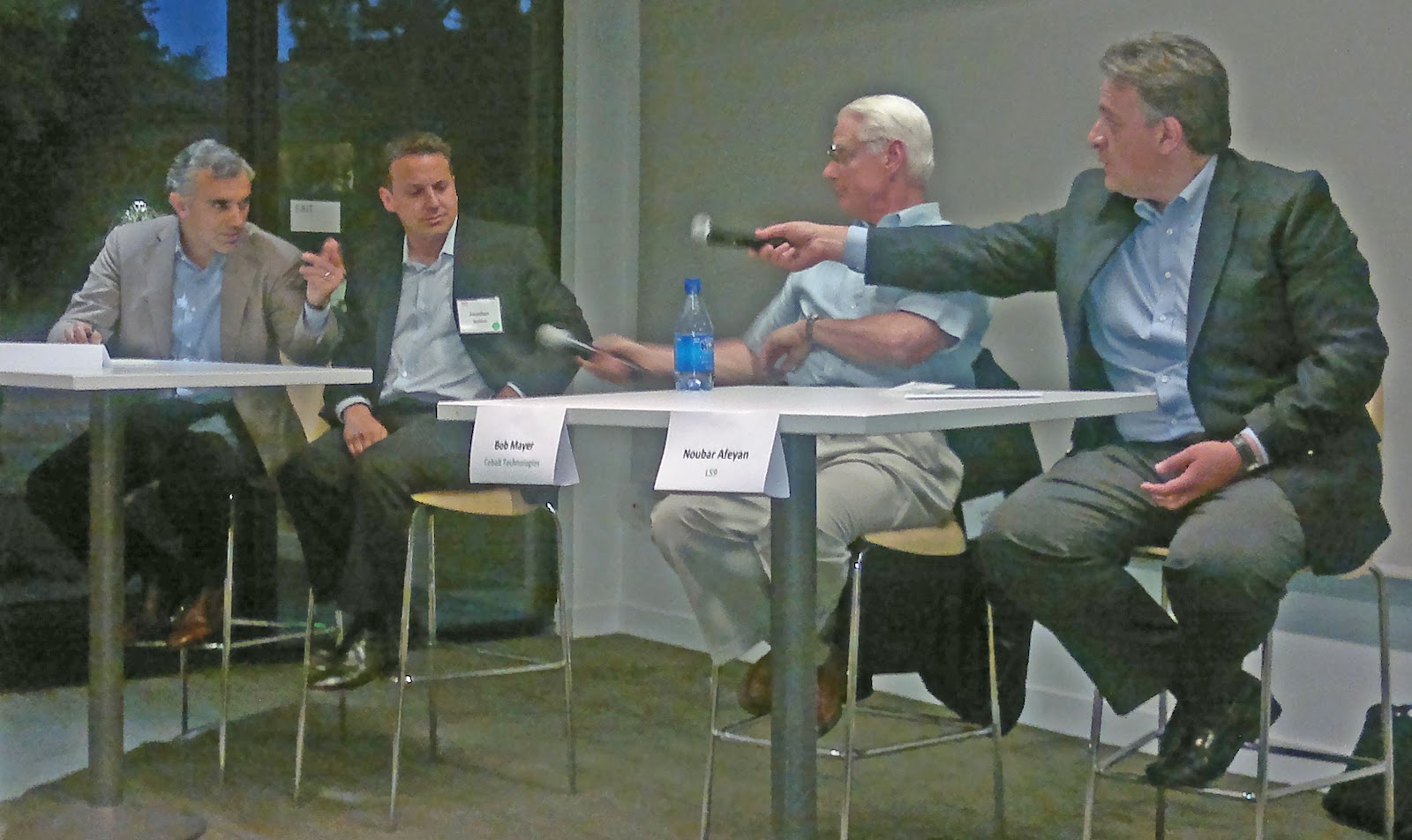
On Tuesday, the MIT alumni club in Silicon Valley hosted a freewheeling discussion by four executives from leading US biofuels companies, discussing the opportunities and challenges of building a new industry from scratch.

Update May 12: The video and program have been posted.

A capacity crowd of more than 100 people heard John Melo (CEO of Amyris), Jonathan Wolfson (CEO and co-founder of Solazyme), Bob Mayer (CEO of Cobalt) and Noubar Afeyan (a VC who is chairman and co-founder of LS9, Midori and Joule) discuss the industry. As the organizer of the event, I was pleased to hear that it was the first time all four had spoken together.

As CEOs of two of a handful of public biofuels companies, Melo and Wolfson have often been paired and seemed ready to complete each other’s sentences; both had just come off earnings calls — Solazyme on Monday and Amryis on Tuesday. For the MIT alumni, it was gratifying to hear that the other two men, Mayer and Afeyan, had doctorates in chemical engineering from MIT, and in fact Afeyan noted his 1987 dissertation was on converting cellulose to ethanol.

The four had a largely convergent view of the business and technical environment. The clear reality is that not having scale or huge balance sheets to fund ramping up to scale, the firms need to be nimble in arbitraging opportunities to more cost-effectively produce commodities that are needed by the market.

However, each emphasized a different approach to making money in that environment:
  • Melo said Amryis is engineering microbes (i.e. yeast) to convert carbohydrates into high-value chemicals. Because of his four years at BP USA — which included squeezing small ethanol plants that lacked their own distribution — he’s convinced that any path to success includes vertical integration.
  • Wolfson quoted Solazyme’s tagline that “we convert low cost plant sugars to high value renewable oils – for fuel, for food, for life.” The emphasis was on technical flexibility that allows creating oils for blending that are in regulatory favor — such as rapeseed oil in Europe.
  • For Cobalt, Mayer said the goal is to ferment hemicellulose to butanol — such as from sugar cane bagasse — without distributing the sugar production. The company hopes to exploit an secular trend in butanol prices rising faster than oil prices, at the same time that natural gas prices fall.
  • As managing director of Flagship Ventures, Afeyan has funded a number of biofuels startups, starting in 2003 with Mascoma that was converting cellulose to ethanol using the same organism (clostridium) that Afeyan studied in his PhD dissertation. He outlind the technologies of three of his companies: LS9 (engineering e-coli to create fatty alcohols), Midori Renewables (using a solid catalyst to degrade cellulose to produce sugar at 1/4 of current prices) and Joule (which would use cyanobacteria to directly convert CO2 to n-alkanes).
Afeyan aptly summed up the challenge of biofuels (and other tech entrepreneurs) when he said that entrepreneurs were chasing “what is not yet known not to work.”
MITCNC panelists (left to right): John Melo, Jonathan Wolfson, Bob Mayer and Noubar Afeyan
A major theme of the industry was partnering — for access to capital, distribution and (presumably) ultimate exit.

Noting a parallel to the funding of the biotech industry by oil and chemicals 30 years, Afeyan wondered when the CEO of the big oil and chemical companies will take a real interest in biofuels (rather than “just run nice ads”).

Mayer held out Dupont as an example of a company that “gets it.” Each of the CEOs had their own key partners. For Amyris it’s Total (a French oil company), for Solazyme it includes Dow, and Cobalt is partnered with Solvay/Rhodia, a specialty chemical company based on Brazil.

Not surprising for an industry that produces commodities (even high value one), the three CEOs repeatedly talked about execution. From his own career, Mayer said “industrial biotechnology is very much about execution.” Melo said the industry needed to “industrialize the process of developing the technology,” much as the biotech industry succeeded in doing. Meanwhile, Wolfson said success for a biofuels company — as with any other innovative Silicon Valley company — was about continuously innovating and creating new technologies to keep ahead of other companies.

The two public company CEOs were very wary of the unpredictable nature of government incentives. As Melo, “the US doesn’t care about long term strategic issues.” He questioned whether the Federal Renewable Fuel Standard will be around in five years, while Wolfson worried about the variability and arbitrary changes in life cycle carbon estimates — whether by private methodologies (such as LCA) or from state or Federal regulators such as the California Air Resources Board.

The challenge for the firms — and the investors — is that building a biofuels industry will take years, with many shifts of market and regulatory forces along the way. Melo said it took John D. Rockefeller 30 years to make oil a successful transportation fuel — although he hopes that biofuels can make it in 15 years. In the meantime, he said the first priority of any firm to generate revenues and cash flow to stick around. Or as Wolfson said, “In order to be involved in a commodity market, you need to be around long enough to get there.”

In the meantime, Melo predicted the next 24 months will bring consolidations and exits for many companies. I am inclined to agree: it probably won’t be as brutal as solar — where there are more companies — but clearly firms without positive cash flow (or at least solid balance sheets) will find it increasingly difficult to get the capital necessary, particularly as the IPO market appears to have closed for biofuels companies.

Wednesday, May 4, 2011

RE: viable niche vs. subsidized mass market?

In Wednesday’s WSJ, engineering consultant Josh Prueher argues that the way to promote renewable energy is to encourage adoption in self-funding niches rather than proffering government subsidies to help spur adoption in mass markets.

Prueher points to the inherent problem with any subsidies:
In the renewable energy industry, subsidies typically involve federal and state governments imposing a small tax or an electricity rate hike on each one of us. The government then awards the proceeds to a few winners that, in the best case, have demonstrated the technical and business potential to grow into competitive companies. In the worst case, they've demonstrated little more than superior lobbying capability. In all cases, subsidies deny the market its proper role of directing capital. It's important to note that the traditional energy industry also receives billions of dollars in government subsidies each year; perhaps it's more effectively hidden from public scrutiny.
The PV entrepreneurs and managers say that subsidies are a necessary evil in the short term but they look forward to when they are no longer necessary. Some seem more sincere than others.

Instead of these subsidies, Prueher notes that we already have a fully functioning unsubsidized market where RE has a cost advantage: the off-grid market. This market — whether rural US or military outposts — is typically served by diesel generators.

The logistics cost of supplying fuel to these generators — whether on an offshore platform or the military front lines — are “staggering”:
For instance, unlike you and me, who pay on average from 3 cents to 16 cents for a kilowatt hour of electricity from the grid, these large consumers pay between 50 cents and $2.
From this, we already know what an unsubsidized RE market looks like:
Those high costs are sending a strong, clear price signal to the energy market to provide cheaper and more reliable sources of electricity and fuel. Namely, we need to develop renewables, energy storage and energy-efficient technologies that do not require expensive logistical support. While the off-grid market is small relative to the on-grid energy behemoth, it is of sufficient size and depth to justify strong competition, private investment and product development—without subsidy.
While he’s right in principle, in practice I don’t see how we get from here to there. The venture-funded SV PV companies and the Chinese-funded Big Five are addicted to purchase subsidies, whether as taxpayer rebates or (as in feed-in tariffs or RPS standards) mandated wealth transfers from electricity users.

If I were doing a bootstrap startup, I’d make a self-funded startup that targeted a cost-effective niche. But the nature of venture-funded startups that their founders/owners have to bet it all on double-zero — to swing for the fences — because it’s better (at least for venture investors) to have a small chance of huge success rather than a good chance of a modest success.

Monday, November 29, 2010

Finding a good niche

As in any other industry, the success of new cleantech businesses usually depends on finding a good niche. Yes, the big oil companies would like to start with billion (or trillion) dollar market segments, but most other companies need to start with a small, well-defined, highly motivated and easy to target segment.

Today the Merc offered a profile of an intriguing electric vehicle company that seems to be taking a different tack than Tesla, Fiskar and the other big VC-funded firms. Green Vehicles Inc. of Salinas (an hour south of San Jose) is selling the Triac, a tricycle commuter car for $25K, with a top speed of 80mph and a “real” (not best case) range of 100 mph round trip.

The $25K MSRP does not include the $7,500 Federal subsidy and a state subsidy (under AB 118) of up to $5,000. So you pay the 10% sales tax on the full $25k, but still the car is cost-competitive (to buy, before operating costs) with conventional cars selling for around $13,500 — and there aren’t a lot of cars in that range. It would get me the 12 miles to work, or the 4 miles to the LRT to work or the CalTrain to San Francisco.

The car is severely limited in size (two people) and like other pure EVs, in range. But to me, this could be the ideal commuter car to throw into the portfolio as a third car, say for households with a teen driver that has a 2-5 mile one-way trip to high school or the mall job.

More importantly, the low up front cost will allow someone to experiment with this restricted-capability vehicle — inherent in pure EV models — to see if it fits their lifestyle. Even if it only holds two people, I think a $14k vehicle (after incentives) has a much bigger audience than the $57k ($35k after incentives) Tesla Model S sedan.

Tuesday, March 23, 2010

Green Technology Entrepreneurship Academy

From Andrew Hargadon’s blog:
Green Technology Entrepreneurship Academy
June 28 - July 2, 2010 @ the Tahoe Center for Environmental Science
Lake Tahoe, Nevada

Moving Sustainable Technologies Out of the Lab and into the World

The one-week intensive academy is open to science and engineering faculty, graduate students, post-doctoral researchers, and senior undergraduates working on research in green technologies. The academy combines seminars and networking sessions in an innovative format to help you learn how to commercialize your technology.
The workshop is presented by UC Davis. The application deadline is May 14, 2010.

For more information, see the complete posting in Prof. Hargadon’s article.

Tuesday, September 22, 2009

Serious RE money

On Monday, one of the Bay Area’s biggest (if not the biggest) energy efficiency companies announced that it had doubled its venture invested capital from $60 million to $120 million.

It certainly is a major development for Serious Materials. As one VC press release explains:
Navitas Capital, a venture capital firm investing in green technology solutions for the built environment, announced today that it participated in a $60 million Series C investment in Serious Materials. According to an Ernst & Young LLP analysis based on data from Dow Jones VentureSource, this transaction represents one of the largest U.S. venture capital deals year-to-date in 2009 and is the largest cleantech deal in the Energy Efficiency category. …

The new funding was led by Mesirow Financial Capital and included New Enterprise Associates, Foundation Capital, Rustic Canyon, Enertech Capital, Cheyenne, and Saints Capital. Navitas is a returning investor, its principals having led Serious Material's initial financing round in 2005.
The Mercury News reports that Serious was founded in 2002 and employs 250-300 people at its Sunnyvale headquarters and five plants around the country. (The company was prominently in the news last April when Vice President Biden visited its Chicago factory).

As it turns out, early this month I met the CEO, Kevin Surace, at a Menlo Park renewable energy event. I had a brief chance to talk with him about his business, although the seating arrangements didn’t allow a more detailed conversation (which I hope to have later).

From talking to Keven, what caught my attention is their efforts to transform the definition of energy efficient windows. Energy efficiency is normally thought of in terms of SHGC or U-value; instead, Serious is selling R-6 windows to save energy over the customary EnergyStar windows rated at R-2 or R-3. I know less about its drywall products, although an architect recommended its unique (and patented) QuietRock for remodeling a room that would be used for practicing music.

I can see why VCs are excited about Serious: it has achieved differentiation through innovation in two huge industry segments. As best as I can tell, the drywall industry in the US is $40+ billion in revenues every year, while the US window industry is about $12 billion/year.

Looking to history, a sudden desire to increase energy efficiency — whether through regulation or market forces — provides a sizable market for both new construction and retrofit applications.

From my childhood, I remember my parents trying to retrofit their 1950s-era designer home with ceiling insulation, which was basically limited to those places that could be covered with blown-in cellulose. Decades later, my girlfriend (now my wife) and I scampered through the rafters of the brick home where I lived, laying down batts of fiberglass insulation to make the summer heat tolerable.

One could argue, in fact, that Owens Corning was the biggest winner of the (limited) US push for energy efficiency in the 1970s. Its pink fiberglass batts (with the Pink Panther branding) have become both a company trademark and the country’s ubiquitous solution for bringing walls and ceilings up to R-19 or R-30 efficiency standards. The ease of installation, low cost and quick payback means that (even without government intervention) that buying yards and yards of pink fiberglass is a no-brainer when building any new home. Today Owens Corning is a $6 billion/year company.

For cold weather locales, SeriousWindows™ offers a similar value proposition. In the Merc story, its CEO emphasizes the bottom line benefits of energy conservation investments that pay for themselves:
The company says its SeriousWindows line reduces heating and cooling energy costs by up to 50 percent, enabling users to recover the additional costs within two years in many climates.

Its EcoRock drywall alternative required 80 percent less energy in its core production than conventional gypsum drywall "and has the potential to save billions of pound of CO2 annually," the company says.

But, Surace added: "We're not out there selling green. We're selling that we can give you your money back."

While Serious Materials supports proposed policy reforms to promote a low-carbon economy, the company doesn't require such reforms to succeed, he said.
An IPO is always a CEO’s first choice, but Serious will also be well positioned for acquisition. Given the most recent valuations, I’m guessing that the acquirer would have to have at least $3 billion in revenues (perhaps more, given Serious will have a high growth multiple). Today, there are a few public building materials companies that big — names like Georgia Pacific, Masco, Mohawk — or Owens Corning.

However, if Serious grows for another few years, it will be too big for an acquisition, and thus a favorable IPO market would be the only option. This would require the IPO market improving from the doldrums it’s been in for more than a year.

Friday, January 9, 2009

OptiSolar: one day, -48% growth

On the 11pm news, one of our local TV stations profiled two local PV companies: one with bad news, one where the news so far is OK.

The bad news was at Hayward-based OptSolar, which is laying off about 300 of its 600 workers. The company’s press release page hasn’t been updated in 5 months and only 2 in 2008. However, press releases are not their thing: the company has long been in stealth mode, with only occasional glimmers of information.

On the TV story, a OptiSolar spokesman is quoted as saying “The economy and access to capital markets have hit us hard.” The best coverage was in the hometown Hayward Argus (sister paper to the San Jose Mercury), which gives the exact numbers as 290 cut and 317 remaining. The paper quotes spokesman Alan Bernheimer as saying
"The major effect of this decision is it suspends our high-volume manufacturing," Bernheimer said.

...

"In this capital market, we just couldn't finance the costs for our expansion," Bernheimer said. "The current work force simply wasn't sustainable. Our expansion was dependent on access to the capital markets. And those dried up starting last September."
Richard Helfrich, managing director of Alamada Capital, was quoted on TV as saying “I thought they would be one of the survivors because they had access to a lot of capital.”

KABC reported that the second company —  SolarCity of Foster City — had raised enough cash in 2008 to stay alive at least for now. Certainly that’s the experience of most early stage Bay Area tech companies right now: if got money, you’re happy, but if you didn’t get money in time, you have to assume that it won’t be coming for a while (if ever).

The difference here is that with the change of regimes, renewable energy (and other cleantech) firms are hoping for a big flood of Federal support for “green” technologies. Will that be R&D subsidies? Purchase subsidies (like tax credits)? And will they come in a form to help capital-strapped firms launch new products, or only to provide cash flow to firms that have products ready to sell?