/* Google Analytics */

Sunday, June 10, 2012

Jerry Brown's white elephant legacy

From the San Jose Mercury News, June 10, 2012, p. A18:
Editorial
Enough. Stop rail fantasy in its tracks

There is a fine line between visionary and delusional. California's high-speed rail project whizzed across that line long ago and now is chugging toward the monorail station at Fantasyland.

The latest end-run tactic by the train's chief engineer, Gov. Jerry Brown, would have California's Legislature suspend its tough environmental laws so the state could put this pet project on the -- pardon the pun -- fast track.

Never mind that every independent analysis of the project has been highly critical of it.

Never mind that the High-Speed Rail Authority's own peer review group said it was terribly flawed.

Never mind that the nonpartisan Legislative Analyst's Office said even the new, new, new and improved incarnation still is not nearly "strong enough" and relies on "highly speculative" funding sources. For the uninitiated, that is bureaucratese for "not a snowball's chance in hell of finding the money to pay for it."
...
Nope, none of that matters. Casey Jones is at the controls of his legacy project, so reason and fiscal prudence must sit this one out.

We say all this despite having supported high pseed rail when it was on the ballot in 2008. Rail is important to America's future, and we knew the first steps towards any visionary plan face hurdles and may require leaps of faith.

But back then nobody foresaw the economic plunge that still leaves California mired in budget deficits. We lost faith in the original board and its planning and construction team. Then last year, an updated plan with wildly higher costs for a smaller system sent us leaping to the sidetrack. (Oopsie, did we say $45 billion? We meant $98 billion. No, no, wait, $68 billion. Well, you know, around there somewhere. Did we say San Diego and Sacramento would be included in those numbers? Drat, our bad, they aren't.)

How could anyone believe a word of what comes from the High-Speed Rail Authority? As to Brown's legacy, he still has to get us tax plan approved in the fall. If voters perceived high-speed rail as a waste of money, they will be more dubious of taxes.
From the San Jose Mercury News, June 10, 2012, p. A19:
Brown risks legacy on bullet train
By Daniel Borenstein

As Gov. Jerry Brown barrels ahead with high-speed trains, he could find that his quest for a legacy derails the November tax measure he desperately needs to repair the state budget.

For his entire political career, Brown has lived in the shadows of his visionary father, Pat, the governor from 1959-67 who brought us the State Water Project and the master plan for California higher education.

The younger Brown has always been a big thinker in search of his own legacy. But, after his first gubernatorial tenure, from 1975-83, he was best remembered as Gov. Moonbeam, the ideas guy who could never deliver, and for his appointment of Rose Bird to the state Supreme Court, which backfired when voters recalled the chief justice and two of her Brown-appointed colleagues in 1986.

We were told during the 2010 gubernatorial election that Brown, then 72, had politically and personally matured, that he was more down to earth, that he had learned from his intervening years in local government as mayor of Oakland.

But he undermines the frugality image by continuing to champion a financially indefensible plan to link the major metropolitan areas of the state with high-speed rail. In his search for his own legacy he risks voter support for his tax measure.

Brown should exercise caution. While he strives to be remembered like his late father for the capital projects he leaves behind, defeat of the tax measure could so badly undermine his financial recovery plans and lead to the gutting of the state's public education system that his legacy might instead resemble that of his former chief of staff, Gray Davis.

Whether voters in November see the connection -- and contradiction -- between Brown's demand for more taxes and his reckless exuberance for spending billions on high-speed rail remains to be seen. A recent USC Dornsife/Los Angeles Times poll of registered voters suggests that's a very real risk.

When voters four years ago authorized issuing up to $9 billion in bonds for high-speed rail, they made it subject to legislative approval. Now, Brown and Democratic leaders in the Legislature are trying to fast-track approval of nearly $3 billion of those bonds to kick-start the project -- even though they have no idea where most of the money for the system will come from.

It's a risky gambit. The governor is seeking legislative approval for high-speed rail bonds roughly four months before voters cast ballots on his tax measure. Does he really want to anger them just when he needs them the most?

Sunday, May 27, 2012

Solving the EV chicken & egg problem

As part of a settlement over the 2001 California energy crisis, NRG Energy promised to spend $100m to build EV charging stations across the state. On Friday a rival charging station company sued to block the settlement.

The settlement itself was fraught with ironies, since many saw NRG as the next most “evil” big business (after Enron) in the whole crisis. The settlement was trumpeted March 23 by Governor Jerry Brown, while the brownouts and blackouts brought the forced retirement (through recall) of his protegĂ©, Gray Davis, who’d been chief of state (and a stabilizing influence) on Brown during his infamous “Governor Moonbeam” days.

According to the GTM coverage of the deal, NRG’s $100m would fund “a statewide infrastructure of at least 200 public fast-charging stations and another 10,000 plug-in units at 1,000 locations.”

There are other aspects of the plan that belong in la-la land, such as the Governor’s vision that (again according to GTM) “California’s personal transportation is to be essentially all-ZEV by 2050.” Fortunately for the state (and the governor), Gov. Moonbeam will be at least 20 years in the ground at that point, with his fanciful promise long forgotten. (For a whole range of reasons ± starting with batteries — electric vehicles will remain a niche product through the first half of this century.)

Still, EVs face a crucial chicken-and-egg problem: they will only get limited adoption without charging stations, and nobody wants to spend big bucks to install charging stations before there is an installed base of EVs. The governor’s settlement of his predecessor’s screw-up allows him to take credit for solving this (very real) “green” problem without spending any taxpayer money (which makes it a rare opportunity indeed). Or, as Michael Peevey, the head of his Public Utilities Commission, noted in the official press release
The settlement will launch a virtuous circle in which ever more Californians will feel comfortable driving EVs, and growing EV sales will in turn attract ever more investment in charging infrastructure to our state.
On Friday, San Francisco-based Ecotality sued the state over the governor’s deal with its competitors. As the Merc reported
Ecotality argues that the agreement "punishes" NRG for price gouging during the energy crisis by allowing it to invest money into its own business.

"Such 'punishment' is equivalent to a motorist settling his speeding citation by simply being required to buy a faster car, subsidized by the public," reads the lawsuit, filed Friday in the 1st District Court of Appeal in San Francisco.
I loathe crony capitalism as much as anyone, but the Ecotality suit seems to be minimizing the very real risk that NRG is running of owning a fleet of white elephants. (If the suit says California should take its lawsuit settlements in cash rather than business investment, that seems like a more promising argument to make.)

Not everyone share’s Ecotality’s pessimism — or fear — about the impact of NRG’s buildout. As the other Bay Area newspaper, the Chronicle reported:
Jay Friedland, legislative director of an electric car advocacy group, said California's market for charging equipment should grow big enough, fast enough for multiple companies to thrive.

"We think this market is going to expand out pretty rapidly," said Friedland, with Plug In America. "And NRG could be a viable player, just like Ecotality and Coulomb could be."
Ecotality is right that NRG will have a leg up if this turns out to be a good business investment, but it’s lying to claim this will create a “monopoly.” (Electric charging stations are no more monopolistic than gas stations — the national market will support at least 3 competitors.)

Yes California is a desirable market to dominate, but if Ecotality wants to build its own stations, it is free (in a free market) to do so. It just needs to find a deep-pocket source of funding — a problem it had before March 23, and a problem that is solvable by selling itself (earlier, at a low valuation) to a major energy company like Edison, Exelon or PG&E.

Saturday, May 12, 2012

Video for all-star biofuels panel

The video from Tuesday’s MITCNC biofuels panel discussion has been posted to MIT’s video channel, TechTV.

For those who were not in Menlo Park, here is the program:


Biofuels:
How Biotech is Changing the Energy Industry

Panelists
John Melo – CEO, Amyris
Jonathan Wolfson - CEO, Solazyme
Bob Mayer – CEO, Cobalt Technologies
Noubar Afeyan – Chairman, LS9

Moderator
Don Keller – Partner, Orrick Herrington & Sutcliffe

May 8, 2012
Orrick, Herrington & Sutcliffe LLP
1000 Marsh Rd
Menlo Park, CA 95025

Participant biographies:

John Melo is CEO of Amyris. Before that, he was president of US Fuels for BP Plc, where built up its ethanol blending business. He serves on the board of Kior and US Venture and previously served ass a director at Ernst & Young in San Jose.

Jonathan Wolfson is CEO and co-founder of Solazyme. He previously served as co-founder and COO of InvestorTree. He is a director of the Clean Economy Network and the Biotechnology Industry Organization. He holds a JD and MBA from NYU.

Bob Mayer is CEO and chairman Cobalt Technologies. His experience in biotechnology includes president of Genencor International and Danisco USA. He holds a ScD in Chemical Engineering from MIT, and was an assistant professor in MIT’s chemical engineering department.

Noubar Afeyan is managing partner and CEO of Flagship Ventures, and is co-founder and chairman of three biofuels companies: LS9, Joule and Midori. He holds a PhD in Chemical Engineering from MIT and serves as a Senior Lecturer at the Sloan School.

Moderator Don Keller is a partner at Orrick, Herrington & Sutcliffe LLP, where he is one of the firm’s 11-member board of director and has advised clients on more than 60 IPOs. He holds a JD from Boston College Law School and serves on its Board of Overseers.

Emcee Joel West is a professor at the Keck Graduate Institute of Applied Life Sciences, one of the Claremont Colleges. He holds a PhD from UC Irvine and a SB from MIT.

Wednesday, May 9, 2012

State of the US biofuels industry

On Tuesday, the MIT alumni club in Silicon Valley hosted a freewheeling discussion by four executives from leading US biofuels companies, discussing the opportunities and challenges of building a new industry from scratch.

Update May 12: The video and program have been posted.

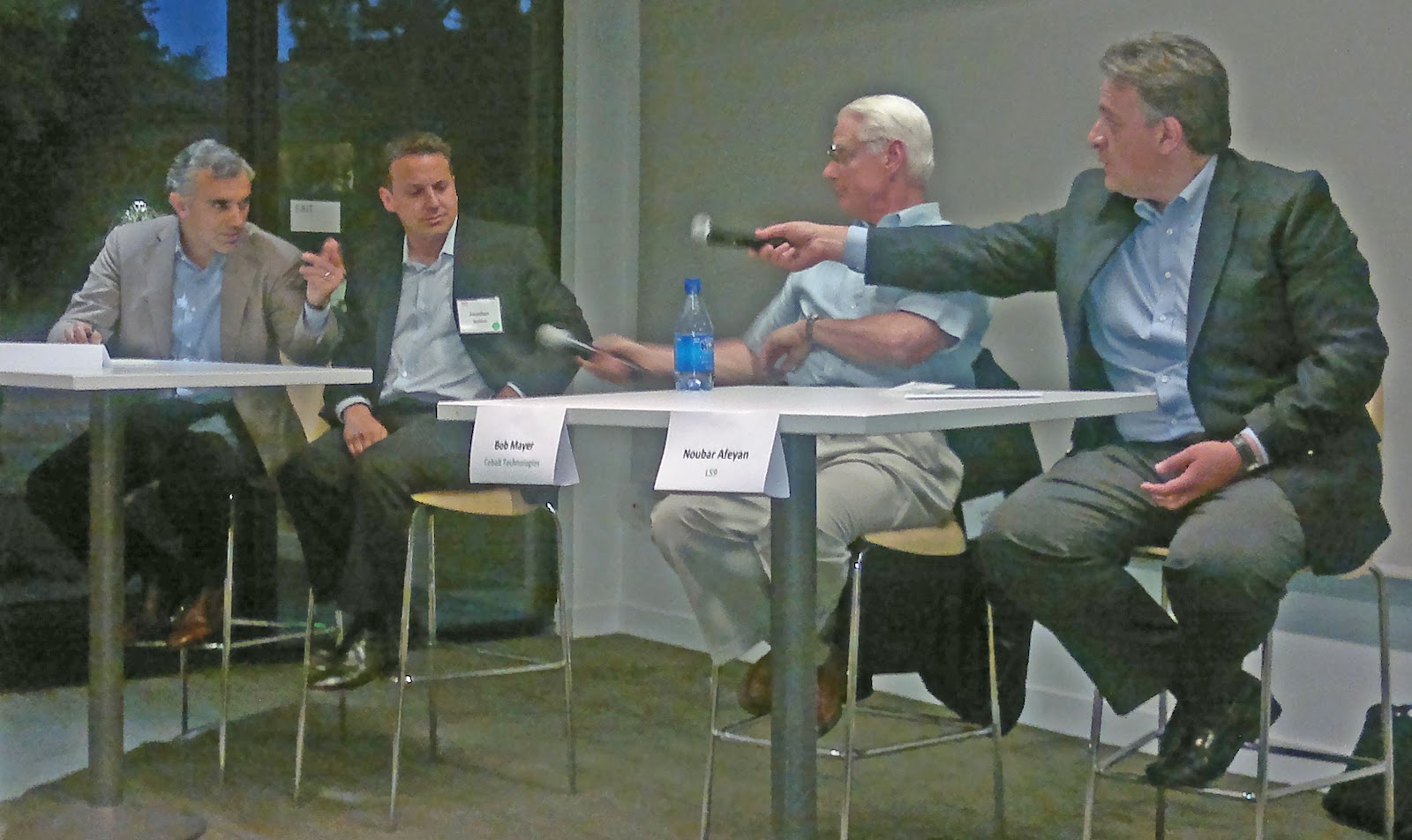
A capacity crowd of more than 100 people heard John Melo (CEO of Amyris), Jonathan Wolfson (CEO and co-founder of Solazyme), Bob Mayer (CEO of Cobalt) and Noubar Afeyan (a VC who is chairman and co-founder of LS9, Midori and Joule) discuss the industry. As the organizer of the event, I was pleased to hear that it was the first time all four had spoken together.

As CEOs of two of a handful of public biofuels companies, Melo and Wolfson have often been paired and seemed ready to complete each other’s sentences; both had just come off earnings calls — Solazyme on Monday and Amryis on Tuesday. For the MIT alumni, it was gratifying to hear that the other two men, Mayer and Afeyan, had doctorates in chemical engineering from MIT, and in fact Afeyan noted his 1987 dissertation was on converting cellulose to ethanol.

The four had a largely convergent view of the business and technical environment. The clear reality is that not having scale or huge balance sheets to fund ramping up to scale, the firms need to be nimble in arbitraging opportunities to more cost-effectively produce commodities that are needed by the market.

However, each emphasized a different approach to making money in that environment:
  • Melo said Amryis is engineering microbes (i.e. yeast) to convert carbohydrates into high-value chemicals. Because of his four years at BP USA — which included squeezing small ethanol plants that lacked their own distribution — he’s convinced that any path to success includes vertical integration.
  • Wolfson quoted Solazyme’s tagline that “we convert low cost plant sugars to high value renewable oils – for fuel, for food, for life.” The emphasis was on technical flexibility that allows creating oils for blending that are in regulatory favor — such as rapeseed oil in Europe.
  • For Cobalt, Mayer said the goal is to ferment hemicellulose to butanol — such as from sugar cane bagasse — without distributing the sugar production. The company hopes to exploit an secular trend in butanol prices rising faster than oil prices, at the same time that natural gas prices fall.
  • As managing director of Flagship Ventures, Afeyan has funded a number of biofuels startups, starting in 2003 with Mascoma that was converting cellulose to ethanol using the same organism (clostridium) that Afeyan studied in his PhD dissertation. He outlind the technologies of three of his companies: LS9 (engineering e-coli to create fatty alcohols), Midori Renewables (using a solid catalyst to degrade cellulose to produce sugar at 1/4 of current prices) and Joule (which would use cyanobacteria to directly convert CO2 to n-alkanes).
Afeyan aptly summed up the challenge of biofuels (and other tech entrepreneurs) when he said that entrepreneurs were chasing “what is not yet known not to work.”
MITCNC panelists (left to right): John Melo, Jonathan Wolfson, Bob Mayer and Noubar Afeyan
A major theme of the industry was partnering — for access to capital, distribution and (presumably) ultimate exit.

Noting a parallel to the funding of the biotech industry by oil and chemicals 30 years, Afeyan wondered when the CEO of the big oil and chemical companies will take a real interest in biofuels (rather than “just run nice ads”).

Mayer held out Dupont as an example of a company that “gets it.” Each of the CEOs had their own key partners. For Amyris it’s Total (a French oil company), for Solazyme it includes Dow, and Cobalt is partnered with Solvay/Rhodia, a specialty chemical company based on Brazil.

Not surprising for an industry that produces commodities (even high value one), the three CEOs repeatedly talked about execution. From his own career, Mayer said “industrial biotechnology is very much about execution.” Melo said the industry needed to “industrialize the process of developing the technology,” much as the biotech industry succeeded in doing. Meanwhile, Wolfson said success for a biofuels company — as with any other innovative Silicon Valley company — was about continuously innovating and creating new technologies to keep ahead of other companies.

The two public company CEOs were very wary of the unpredictable nature of government incentives. As Melo, “the US doesn’t care about long term strategic issues.” He questioned whether the Federal Renewable Fuel Standard will be around in five years, while Wolfson worried about the variability and arbitrary changes in life cycle carbon estimates — whether by private methodologies (such as LCA) or from state or Federal regulators such as the California Air Resources Board.

The challenge for the firms — and the investors — is that building a biofuels industry will take years, with many shifts of market and regulatory forces along the way. Melo said it took John D. Rockefeller 30 years to make oil a successful transportation fuel — although he hopes that biofuels can make it in 15 years. In the meantime, he said the first priority of any firm to generate revenues and cash flow to stick around. Or as Wolfson said, “In order to be involved in a commodity market, you need to be around long enough to get there.”

In the meantime, Melo predicted the next 24 months will bring consolidations and exits for many companies. I am inclined to agree: it probably won’t be as brutal as solar — where there are more companies — but clearly firms without positive cash flow (or at least solid balance sheets) will find it increasingly difficult to get the capital necessary, particularly as the IPO market appears to have closed for biofuels companies.

Saturday, April 28, 2012

What is the least bad RE?

On Thursday I started my course on renewable energy at San Jose State. As far as I know this is the first time EE/RE has been covered in the College of Business, and is the net result of the SJSU Solar Workforce Project (July 2010 - June 2012) funded by the state of California and the Green Innovation Challenge.

One of the questions I asked students was: which renewable energy is least bad? For “bad” I meant expensive, less useful, technically infeasible or other issues. (We didn’t bother to do this with coal and other fossil fuels because I’d already covered those issues in the opening lecture).

Everyone had a preferred energy source, but then the others in the room shot holes in it.

First up was biofuels. Biofuels are scalable, but they tend to divert agricultural land from food production (or divert food from eating to energy production) and thus increase the price of food. They also deplete the soil.

Next up was solar. It’s a great way to produce RE, but the most capital intensive energy generation approach available. It also ties up land (in some parts of the country, at least) that has other valuable use. And if the panels are made with CdTe or other toxic chemicals, you have to do something with them.

Wind — like solar — has a storage problem. Like utility scale solar, and coal, there are often transmission line costs and losses from the location where the wind exists (e.g. from the Midwest back to the Northeast). Its time of day generation is unpredictable. It also has its problems obstructing the views of locals and killing birds.

To me, hydro seemed like the no brainer — it's the lowest capital cost of any RE, with a proven technology. Unlike solar and wind, it allows generation when power is needed rather than when the energy is available. However, as a student from Pakistan pointed out, installing a dam by definition floods existing lands, and can displace farmers and villagers from their existing locations. (She also note that as with other water claims, the upstream choices for hydro generation impacts the hydro generating options downstream).

I don’t know why I forgot about the environmental impact of dams. The most notorious case in California is the Hetch Hetchy Valley in Yosemite National Park. Some 90 years ago, John Muir (and now the Sierra Club) fought unsuccessfully to keep San Francisco from flooding the Sierra mountain valley that Muir argued was every bit as beautiful as the Yosemite Valley.

At first glance, this might be a depressing conclusion. But the reality is that unless we want to go back to the horse and buggy, our economy requires energy. Life is full of tradeoffs, and a key theme of the course is using tools of economic analysis to optimize the allocation of scarce public or private resources to achieve environmental (or other) goals.

Sunday, April 22, 2012

All-star biofuels panel May 8

On May 8, I will be emcee for an all-star biofuels panel that I’ve been working for the past 5 months to organize. We will have under one roof the top execs of four of the Bay Area’s leading biofuels companies, at a panel discussion sponsored by the MIT Club of Northern California and its “Energy & Clean Tech Series.”

In alphabetical order, we have confirmed:
  • Noubar Afeyan – Chairman and co-founder, LS9
  • Bob Mayer – CEO and Chairman, Cobalt Technologies
  • John Melo – CEO, Amyris
  • Jonathan Wolfson - CEO and co-founder, Solazyme
These represent three of the five top companies in the Biofuels Digest Top 50 list of US biofuels companies: Solazyme (#1), Amyris (#2), LS9 (#5). The first two of these companies are among 13 publicly traded firms in the Biofuels Digest Index.

Meanwhile, Wolfson, Melo and Mayer are among the Biofuels Digest “Top 100 People in Bioenergy.” Wolfson and Melo are #5 and #6 on the list, after the secretary of agriculture, two BP execs, a Brazilian CEO and the CEO of Sioux Falls-based Poet. Both Melo and Mayer have decades of oil and chemical industry experience, with BP (Melo) and Danisco (Mayer).

Noubary Afeyan is different from the others: rather than an operating role at LS9, he is the managing partner (and founder) of Flagship Ventures. Based in Boston, he lists co-founding roles for 24 life science and technology startups.

I had lots of help from Jim Lane, editor of Biofuels Digest, who thought it an impressive panel when we only had three names. This will be the first opportunity for most Bay Area cleantech investors, employees and aficionados to see all these executives under one roof. Given the technology overlaps between biotech and biofuels, we’re also hoping to attract employees (and MIT alumni) from local biotech firms.

The event is hosted by Orrick, Herrington & Sutcliffe, and our moderator is Don Keller, a senior partner and a member of the firm’s board of directors. As organizer, I will provide a brief background on the industry and then turn it over to Don to introduce our panelists and moderate the discussion and audience Q&A.

The event (which includes dinner and networking) runs from 6:00-9:00 p.m. at Orrick’s Silicon Valley offices in Menlo Park. Advance registration is requested.

Friday, April 6, 2012

Oil and biofuel companies as 'frenemies'

Reuters highlights the cooperative and competing interests of biofuels companies and traditional oil companies in an article entitled “Oil, biofuel companies evolve into uneasy ‘frenemies’.”

The term is attributed to my friend Jim Lane, the biofuel industry’s most influential journalist:
“They're kind of ‘frenemies,’” said Jim Lane, publisher of the Biofuels Digest, noting the two sides have worked together at times and been at odds on other occasions.
The friend part is easy: oil companies are buying and partnering with bioufels companies and also making their internal investments. The article mentions acquisitions by BP, partnership by Chevron and internal investments by Exxon. This is what we in b-schools call a natural complementarity: oil companies have distribution and capital, while biofuels companies have a new product that may become more desirable than the existing one. Big Pharma and biotech companies have enjoyed the benefits of such complementarities for almost 30 years.

Jim Lane highlighted another example of such collaboration in his report Thursday from the Advanced Biofuels Leadership Conference, on a talk by Philip New, head of BP Biofuels:
Even for long-time observers or supporters of alternative energy, it is a startling thing to hear a division head at an oil major, presiding over a duchy consisting of upstream energy assets in the UK, US and Brazil and having 4,000 employees in his care – talking in terms of becoming an owner-operator of energy assets in Brazil. Making the decision to take on agricultural risk and operate beyond proxies like joint ventures.

And, most startling of all, leading the call for the preservation of the US Renewable Fuels Standard, or RFS2.

Weren’t the opponents of RFS2 supposed to include the incumbent oil majors? Weren’t they the forces of “drill, baby, drill”?
Meanwhile, some of the “enemy” claims by the Reuters author are just silly:
Oil companies have long been skeptical of the economics of corn-based ethanol, once derided by Exxon Mobil CEO Rex Tillerson as "moonshine," as well as federal rules that called for the fuel to make up as much as 10 percent of the gasoline supply.
In other words, widespread reporting about the impacts of corn ethanol upon food prices are a plot by Big Oil to sabotage the biofuels industry. By this definition, Bill Clinton and Al Gore are part of some vast right wing conspiracy.

Other aspects of the “enemy” perception are populist attempts to create an enemy:
"You're faced with a very well-financed group of people who don't necessarily want this industry," Agriculture Secretary Tom Vilsack told the Advanced Biofuels Leadership Conference this week.
In other words, the difficulties of the biofuels industry are not due to unproven technologies and difficulties competing with inexpensive and proven commodities, but due to some conspiracy by evil Big Oil. (About what you’d expect from a small town lawyer and politician.)

True, the American Petroleum Institute did sue last month to block the cellulosic fuel mandate in the Renewable Fuel Standard.
“EPA’s standard is divorced from reality and forces refiners to purchase credits for cellulosic fuels that do not exist,” said API Director of Downstream and Industry Operations Bob Greco. “EPA’s unrealistic mandate is effectively a tax on manufacturers of gasoline that could ultimately burden consumers.”
The online magazine Ethanol Producer helpfully explained:
API filed requests with the EPA in 2011 and in early 2012 asking it to reconsider the cellulosic biofuel volume mandate. According to API, the EPA has not responded to either request which is why the group has elected to file a lawsuit on the matter. Ultimately, the group would prefer a cellulosic volume mandate that is based on two months of proven production rather than on anticipated production levels. The EPA has repeatedly stated in its final rules on cellulosic volumes, however, that it believes it should be optimistic when determining cellulosic volume requirements in order to provide incentive for growth in an emerging industry.
Unfortunately, the energy industry faces a chicken-and-egg problem: the problem of scaling to produce cost-effective substitutes for traditional energy requires massive investments in R&D and capital, which are too risky to be made without a subsidy or mandate. As Philip New noted, Brazil’s efforts to shift energy supply took more than 20 years. (The alternative is to wait for oil to hit $200/barrel and then spend decades trying to address the problem).

Still, the country would be far better served by having a technology-neutral RFS policy that incentivized any approach that didn’t displace farmland for fuel. As in the renewable electricity mandates (e.g., California’s Renewable Portfolio Standard), the government should harness the market to encourage investment in the most promising and cost-effective technologies. Or as a Purdue professor wrote in a 2010 critique of US biofuels policy:
A technology- and feedstock-neutral policy is clearly preferred to one in which”the government weighs in heavily on technology choice.
A centrist president might be able to initiate a policy that encouraged scaling up biofuels production without subsidizing any specific technology. That would include modifying RFS to be more technology-neutral, to allow algae and other feedstocks that can be grown on barren land in the Southwest and Southeast.